Where to buy in Languedoc and the South of France: Uzès, Nîmes, Montpellier, Sète, Collioure, Toulouse, Albi
Languedoc is not one place but a string of very different ones: the honey-coloured stone of Uzès, the canals of Sète, the terraced vineyards of Collioure, and further west the other Occitanie, built in red brick, from Toulouse to Albi. This guide compares them area by area: what you can buy, at what price according to recorded sales, for what kind of life, and what to check before you sign.
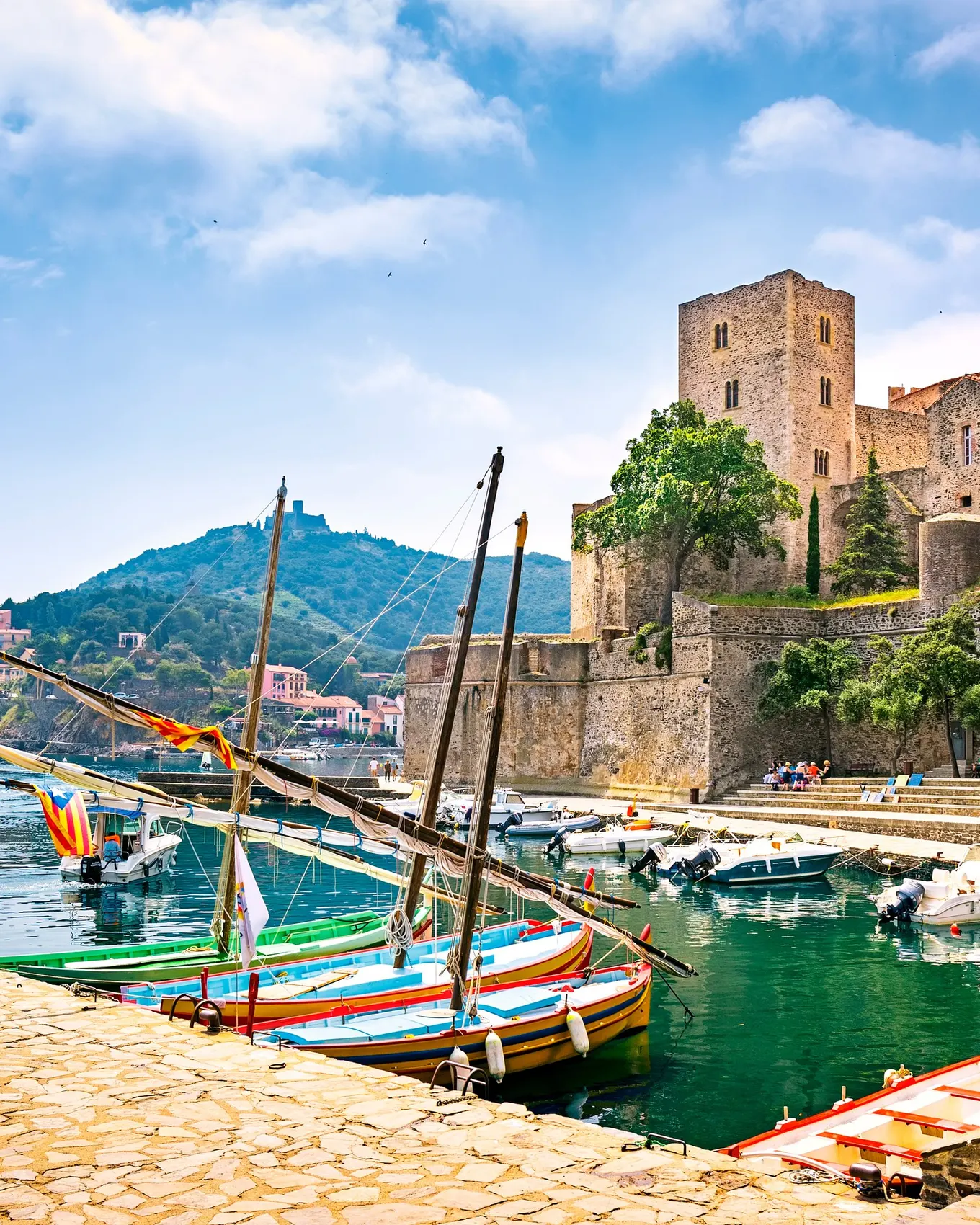
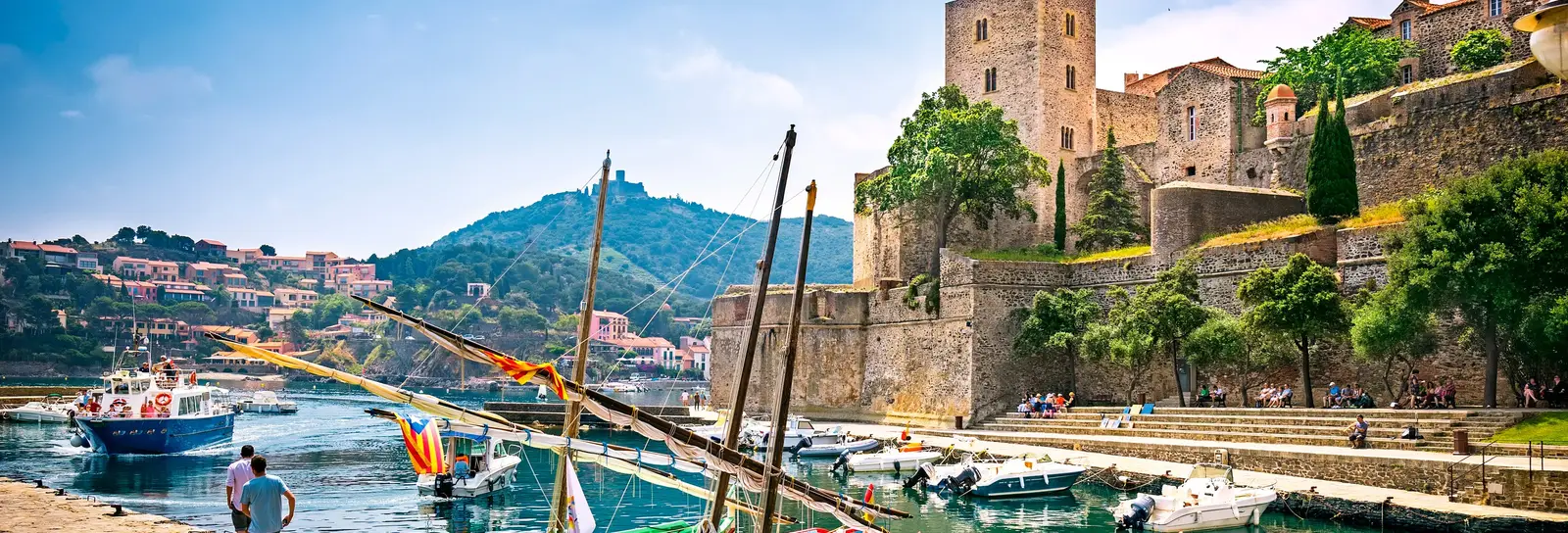
Occitanie -Collioure -The royal castle and the Catalan boats
By Jean Mascla, founder of Home SelectUpdated · 13 min read
Languedoc, Occitanie, South of France: what do the names cover?
Languedoc is first a historic province, which ran from Toulouse to the Rhône. Until 2015, the Languedoc-Roussillon region grouped the Gard, the Hérault, the Aude, the Pyrénées-Orientales and the Lozère; since 2016 it has formed, with Midi-Pyrénées, the Occitanie region, whose capital is Toulouse. English-speaking buyers say “Languedoc” for the coast and hinterland between the Camargue and Spain, and “the South of France” for the whole of the Midi.
The map that matters to a buyer is simpler: Uzès, the Uzège and Nîmes in the Gard; Montpellier, its hinterland, Sète and the Thau lagoon in the Hérault; the Côte Vermeille, more Catalan than Languedocian, in the Pyrénées-Orientales. To the west, Toulouse and Albi change material: brick instead of stone, cities to live in rather than holiday retreats.
How much does a house cost in Languedoc? The towns compared
A house costs markedly less in Languedoc than around Aix and Marseille or on the French Riviera. By department, the median house sells for €2,600/m² in the Gard, €3,000/m² in the Hérault and €2,600/m² in the Pyrénées-Orientales, against €4,100/m² in the Bouches-du-Rhône and €5,500/m² in the Alpes-Maritimes.
Medians of recorded sales (DVF / DGFiP via data.gouv.fr, October 2026 release, 12 months to end of June 2026). Sales count houses and apartments; a dash marks a property type sold too rarely to publish a reliable median.
Town
What you buy
Houses, median
Apartments, median
Sales in a year
Access
Uzès
Private mansions, village houses, farmhouses
€3,800/m²
€3,300/m²
175
Nîmes TGV 45 min away
Nîmes
Private mansions, townhouses with courtyards
€2,800/m²
€2,200/m²
2,367
TGV, Paris in about 3 h
Montpellier
Private mansions, apartments, villas
€3,700/m²
€3,400/m²
4,538
TGV, airport, sea 15 min away
Sète
Fishermen’s houses, water views
€4,800/m²
€3,400/m²
1,135
Montpellier 40 min away
Collioure
Village houses, views over the bay
-
€5,300/m²
85
Perpignan 30 min, Barcelona 2 h
Toulouse
Private mansions, houses with gardens
€3,700/m²
€3,300/m²
8,334
International airport, TGV
Albi
Private mansions, brick houses
€2,000/m²
€2,300/m²
637
Toulouse 50 min by direct train
A median places a market, not an address. In Uzès, eight house sales in ten fall between €2,400/m² and €6,600/m²; in Montpellier, one house in ten sells above €5,600/m². The prestige market lives in that last decile, and it is often negotiated away from the listings.
Uzès and the Uzège: where to buy a stone house in the Gard?
Uzès is the Gard’s prestige address for a stone house in town, and the surrounding Uzège the place for a mas, the stone farmhouse of the South. France’s first duchy, a small town of some 8,500 people, revolves around the arcaded place aux Herbes and its Saturday market. Its French and international buyers set price levels that are high for the Gard: €3,800/m² median for a house, €3,300/m² for an apartment, across 175 sales in a year.
The old town or the countryside?
The old town sells village houses with rooms on uneven levels, apartments in 17th and 18th century mansions, more rarely a whole mansion, almost always privately; the Bourrac and the old outlying quarters offer simpler houses with courtyards. Around the town, the Uzège unfolds its stone villages among vines, olive trees and garrigue scrubland: Saint-Quentin-la-Poterie, Montaren, Arpaillargues, Saint-Siffret, Vallabrix. The Pont du Gard is twenty-five minutes away.
Water: mains supply, declared borehole or well, and a pool that a drought order may forbid you to fill.
Drainage: most farmhouses have a private septic system, whose inspection must be less than three years old at the sale.
Brush clearance: usually fifty metres around the buildings, including on the neighbour’s land if the boundary is closer.
Land: farmland sold with the house gives the SAFER, the rural land agency, a right of pre-emption.
Yes, for a real city and great heritage at measured prices. Nîmes, a city of some 150,000 people, lives among its Roman monuments: the arena, the Maison Carrée listed by UNESCO in 2023, the Tour Magne above the Jardins de la Fontaine. Paris is three hours away by TGV, Montpellier half an hour. A house sells for €2,800/m² at the median, an apartment for €2,200/m², across 2,367 sales in a year.
The Écusson, the pedestrian old town: private mansions behind their carriage doors, often in need of restoration.
The Jardins de la Fontaine and the quay: residences and upper floors overlooking the gardens, rarely for sale.
Avenue Feuchères: 19th century stone facades and grand apartments between the station and the Esplanade.
Montaury and the heights: houses and villas with gardens, space and quiet, at the price of a car.
Around the city, the Vaunage to the west and the Costières to the south offer farmhouses with land a quarter of an hour from the centre. In town, old buildings call for a survey: co-ownerships sometimes held jointly by heirs, poor energy ratings, a flood risk to check street by street. Our pages on a buyer’s agent in Nîmes and buying a house in Nîmes cover the neighbourhoods and the properties to watch.
Montpellier and its hinterland: city, sea or vineyards?
Montpellier is the deepest and most dynamic market in Languedoc: 4,538 sales in a year, €3,400/m² median for an apartment, €3,700/m² for a house, a rarer find within the city. The top of the market lies in the Écusson, whose private mansions, among the finest in the South, almost always sell without a listing; families aim for the Arceaux, Boutonnet and Aiguelongue, and Port Marianne gathers contemporary architecture, to be sifted on the quality of each building.
The sea twenty minutes away
Palavas-les-Flots, Carnon and La Grande-Motte, with its white pyramids, form the city’s seaside crown. Many buyers weigh an apartment in town against a house near the sea: two different markets, which Home Select searches in parallel.
The hinterland: the Pic Saint-Loup, the Hérault valley, Pézenas
To the north, the villages of the Pic Saint-Loup, among vineyards and pine woods, offer houses with land half an hour from the city. To the west, the Hérault valley, from Saint-Guilhem-le-Désert to Aniane, and Pézenas, Molière’s town of private mansions, bring stone and countryside within three quarters of an hour. Our pages on a buyer’s agent in Montpellier and buying a villa in Montpellier cover the city and its surroundings.
Sète and the Thau lagoon: where to buy by the water?
Sète is the place in Languedoc to live by the water all year round. The “singular island” stretches between the sea and the Thau lagoon, around the Mont Saint-Clair: canals, swing bridges, fishing and yachting harbours. The market runs at two speeds, with renovated quays and water views hotly contested and a lasting discount elsewhere: the median house reaches €4,800/m², one in ten sells above €9,600/m², and an apartment sells for €3,400/m² at the median.
The Mont Saint-Clair: the sea on one side, the lagoon on the other, steep streets, a car essential.
The old town and the canals: fishermen’s houses and apartments facing the water, hotly contested once renovated.
The corniche and the beaches: the seafront, the busiest season, and salt air that wears down facades.
La Pointe-Courte: the fishermen’s quarter filmed by Agnès Varda in 1955, with its low houses and village rules.
Around the lagoon, Bouzigues, Mèze and Marseillan live from their oyster beds. As the lagoon is salt water, French coastal law applies there as it does by the sea: new building near the shore remains the exception. Our pages on a buyer’s agent in Sète and buying a house in Sète cover the neighbourhoods, and the guide to buying seaside property lists what to check.
Occitanie -Collioure -The royal castle and the Catalan boats
Collioure and the Côte Vermeille: should you buy in French Catalonia?
Collioure is the most sought-after village on the French Catalan coast, and the rarest. South of Perpignan, the Côte Vermeille is more Catalan than Languedocian: Roussillon has only been French since the Treaty of the Pyrenees in 1659. Matisse and Derain invented Fauvism here in 1905, between the royal castle, the bell tower of Notre-Dame-des-Anges and the terraced vineyards. The market is tiny: 85 sales in a year, apartments at €5,300/m² median, one in ten above €7,300/m²; houses sell too rarely for a median to be published.
Le Mouré and the old town: colourful houses, stepped lanes, the bay at the end of every street; sales there come one at a time.
The heights: villas with plunging views over the bay, among the schist terraces.
Port-Vendres, five minutes away: a harbour town alive all year round, at gentler prices.
Banyuls-sur-Mer and its vineyards facing the sea; Céret, half an hour inland, and its cherry orchards.
The tramontane, the north-west wind, blows often and hard; the village fills up in summer and partly empties in winter. Perpignan is half an hour away, Barcelona two hours. Our pages on a buyer’s agent in Collioure and buying a house in Collioure cover this market, where constant watch and a local network make almost all the difference.
Toulouse and Albi: why look at the other Occitanie?
Because you buy brick heritage in cities that live all year round. Toulouse, France’s fourth-largest city, driven by aerospace, is a fast, local market: 8,334 sales in a year, €3,300/m² median for an apartment, €3,700/m² for a house, one in ten above €5,900/m². The mansions of the Carmes, the houses with gardens of the Chalets and the Côte Pavée, the estates on the hills of Vieille-Toulouse make up the top of the market, often sold before any listing.
Albi, fifty minutes from Toulouse by direct train, lines up the Sainte-Cécile cathedral and the Berbie palace above the Tarn: its episcopal city has been a UNESCO World Heritage Site since 2010. A house sells for €2,000/m² at the median, an apartment for €2,300/m², across 637 sales. Around it, the Tarn of vineyards and bastide towns, from Gaillac to Cordes-sur-Ciel, is searched to order.
Toulouse, for year-round family life: jobs, universities, an international airport, international schools.
Albi, for a private mansion or a brick house at measured prices, with Toulouse within reach by train.
Neither is a holiday resort: the Mediterranean and the Pyrenees are about two hours away by road.
What is life like in Languedoc? Access, seasons, schools
The TGV puts Nîmes about three hours from Paris, Montpellier three and a quarter, Sète four and Perpignan about five. Toulouse-Blagnac, Montpellier, Perpignan, Nîmes, Béziers and Carcassonne have airports, with Marseille and Barcelona as alternatives. The A9 motorway runs along the coast to Spain, the A61 links Narbonne to Toulouse, and the A75, toll-free except for the Millau viaduct, climbs north into the Massif Central.
Summers are hot and dry, with the scrubland watched for fire; autumn brings the Cévenol episodes, violent rains that swell the Gardon and Vidourle rivers; winters are mild on the coast, and the tramontane sweeps through Roussillon. Montpellier, Nîmes, Sète, Toulouse and Albi live all year round, as does Uzès, more quietly in winter; Collioure and the coastal villages partly empty out of season.
The fullest international schooling is in Toulouse, thanks to aerospace: the International School of Toulouse and the Lycée International Victor Hugo, both in Colomiers. Elsewhere, international sections and bilingual programmes have to be checked school by school: our guide to schooling in France explains how, and the guide to buying a second home helps with the choice of a holiday house.
Which rules should you check before buying in Languedoc?
Each area adds its own constraints to the standard surveys: they cannot be negotiated, but they can be read before the offer, and some change the price.
Coastal law, by the sea as on salt lagoons such as Thau: development is tightly framed, and a strip along the shore stays unbuildable outside built-up areas.
Compulsory brush clearance in fire-prone communes: usually fifty metres around buildings, a duty that the information given to the buyer must now mention.
Private septic systems for farmhouses: an inspection less than three years old at the sale, and works within a year if the system fails.
Flood risk, very present in the Gard, hit at Nîmes in 1988 and across the department in 2002: the risk statement, the prevention plan, past claims.
Clay soils around Toulouse and in the Tarn, which swell and shrink: cracks, past claims, the commune’s natural disaster orders.
The protected historic centres of Uzès, Nîmes, Montpellier, Toulouse and Albi: facades, windows and roofs go through the state heritage architect, the Architecte des Bâtiments de France.
Farmland and vineyards sold with a farmhouse, over which the SAFER may exercise its right of pre-emption.
The council tax on second homes, which communes in high-pressure housing areas, Montpellier and Toulouse among them, may increase.
When to buy in Languedoc? The market calendar
In spring and early summer, new listings and viewings multiply; in July and August people view a great deal, but notaires’ offices slow down. Autumn, after the grape harvest, lends itself to negotiating a property that stayed on the market all summer; in winter, supply thins out, but the sellers still there mean business.
The brief and the financing, settled before the viewings.
The offer, then the preliminary contract, with a ten-day cooling-off period for the buyer.
The notaire’s timeline, usually two to three months: financing, clearance of pre-emption rights, title and planning checks.
The final deed, with acquisition costs of 7 to 8% on existing homes.
Rare properties do not wait for the season: a mansion in Uzès or a house in old Collioure sells when its owner decides, often to a buyer the notaire already knows. Being ready matters more than the month of the year.
How Home Select searches in Languedoc and Occitanie
Home Select has worked solely for buyers since 2011. In Languedoc, the search starts with a brief that settles the real trade-offs: town or countryside, sea or vineyards, a main home or a holiday house, a property to restore or one ready to move into.
A daily watch of listings and agencies, from Nîmes to Collioure and from Montpellier to Albi.
Off-market properties, which notaires, families and agencies offer first to a serious buyer.
Pre-viewings, on site and by video, so that you only travel for the properties that live up to their promise.
A survey before the offer, then the negotiation and support up to the final deed.
Frequently asked questions
Where should I buy a prestige home in Languedoc?
In central Uzès and among the farmhouses of the Uzège, in Montpellier’s Écusson and its period neighbourhoods, on the Mont Saint-Clair and the quays of Sète, in old Collioure and on its heights. Nîmes offers mansions to restore at more measured prices.
Is Languedoc cheaper than Provence and the French Riviera?
On average, yes: the median house sells for €2,600/m² in the Gard, against €2,900/m² in the Vaucluse and €5,500/m² in the Alpes-Maritimes (DVF / DGFiP via data.gouv.fr, October 2026 release, 12 months to end of June 2026). Uzès, Sète and Collioure, however, command prices well above their department’s level.
Uzès or Nîmes: where should I buy in the Gard?
Uzès for a small, very international town of character, at €3,800/m² median for a house. Nîmes for a real city, the TGV on the doorstep and mansions to restore, at €2,800/m². Many buyers look at both, and at the countryside in between.
Can you live in Languedoc all year round?
Yes: Montpellier, Nîmes, Sète, Toulouse and Albi live all year round, as does Uzès, more quietly in winter. The seaside villages, Collioure included, partly empty out of season, and inland a car is essential.
Where can I buy by the sea in Languedoc?
In Sète and around the Thau lagoon, in Palavas-les-Flots, Carnon or La Grande-Motte, twenty minutes from Montpellier, and on the Côte Vermeille, from Collioure to Banyuls-sur-Mer. With coastal law limiting new building, the market is mostly made of existing homes.
Which town in Occitanie is best for a family?
Toulouse and Montpellier, for jobs, universities and schools, with Toulouse offering the fullest international schooling. Nîmes and Albi offer cities on a human scale and houses with gardens at more measured prices.
How much does a buyer’s agent cost in Languedoc?
The same fees as anywhere else: 2.5% of the net purchase price on the Exclusive offer, minimum €10,000 including VAT, or 1.5% on the Confidential offer, reserved for projects of €2m and above, plus 10% of the negotiated reduction, VAT included, in both cases. Nothing is due before the final deed; the details are on our fees page.
Uzès, Montpellier, Sète or Collioure, town or countryside? Describe your project: a Home Select buyer’s agent will tell you what can be found, where, and how.
Your request is already sent, simply pick what suits you.
A buyer’s agent calls you back within one working day.
🇫🇷+33
An error occurred. Please try again.
Then answer 3 quick questions to be matched with the right hunter.
Home Select processes your data (name, email, phone, project) to handle your request and contact you. It is recorded in our follow-up tool and read by the hunter in charge of your project. Our technical providers access it for hosting, email and checking that your email and number are real, some of them from the United States under the safeguards set by the GDPR. We keep it for three years after our last exchange, or five years after the end of our assignment if you entrust it to us, as French anti-money-laundering law requires. To access, correct or erase it, or to object to its use: contact@home-select.fr. Details in our privacy policy.
Your hunter calls you back within one working day.
Resume your request?
You started a request recently. Pick up where you left off, or start over.
Your answers are kept for 24 hours.
What is your project?
Takes 1 minute, no commitment.
Where are you looking?
Select one or more cities or areas
Your budget?
€
You pay only when Home Select finds it.
Anything to add?
Optional. Add any useful details: specifics about your search, constraints or your availability.
This helps your hunter prepare for your call.
An expert will contact you shortly
Your brief
Confidential search: your file goes to a senior hunter.
60 rue François 1er, 75008 Paris · FCI member
FeesOne month’s rent excluding charges, plus VAT, with a minimum of €2,000 including VAT. Payable only when the lease is signed. No application fee.
Step 1 of 2 · Your search
What are you looking for?
Furnished, unfurnished or both?
In which city?
One or more cities or areas.
€ / month
Charges included, as in the listings.
You would like to move in
Two minutes, no documents needed at this stage.
FeesOne month’s rent excluding charges, plus VAT, with a minimum of €2,000 including VAT. Payable only when the lease is signed. No application fee.
Step 2 of 2 · Your situation
Your situation
These answers let Home Select tell you quickly, and frankly, whether your search can succeed on the market in your city.
You are applying
€ / month
Before tax, regular bonuses included, for everyone applying.
Main applicant’s employment
Your company is based in France
Number of annual accounts filed
To strengthen your file
Optional for your profile. A guarantee reassures landlords.
Guarantor’s situation
€ / month
Who it is for, why you are moving, what matters to you. Do not include sensitive information (health, origin, religion, family situation).
Your contact details
🇫🇷+33
Reply within 24 business hours.
Home Select processes your data (name, email, phone, project, employment, income, guarantee) to review your rental request and contact you. Your answers are compared with the criteria landlords apply, then read by Home Select’s rental hunter. A request that cannot succeed receives a written reply within 24 business hours, and you can ask for it to be reviewed again at contact@home-select.fr. Our technical providers access it for hosting, email and checking that your email and number are real, some of them from the United States under the safeguards set by the GDPR. A request that does not lead to an assignment is erased after three months; otherwise, we keep your data for three years after our last exchange, or five years after the end of our assignment if you entrust it to us, as French anti-money-laundering law requires. To access, correct or erase it, or to object to its use: contact@home-select.fr. Details in our privacy policy.
FeesOne month’s rent excluding charges, plus VAT, with a minimum of €2,000 including VAT. Payable only when the lease is signed. No application fee.
Your file
Your file matches what landlords expect
Book your meeting with Stéphane Martins, rental hunter. He confirms it after reading your file, within 24 business hours.
Choose your time slot
Times shown in Paris time.
Confirmation arrives by email and text message.
FeesOne month’s rent excluding charges, plus VAT, with a minimum of €2,000 including VAT. Payable only when the lease is signed. No application fee.
Your request
Your request is in good hands
Stéphane Martins, rental hunter, is reviewing your file and will reply within 24 business hours.
You will receive a confirmation email.
You arrived through one of Home Select’s ads or campaigns.Ad measurement.Do you agree to Home Select measuring how well it works? Home Select will know which campaign brought you here and, if you get in touch, the ad platform will only learn that its ad worked, without receiving your contact details.Do you agree to Home Select measuring how well its ads work? If you arrive through one of them, Home Select will know which one and, if you get in touch, the ad platform will only learn that its ad worked, without receiving your contact details.Learn moreYour current choice: .