Buying a seaside property in France: the buyer’s guide
Buying a house by the sea in France, or a sea-view apartment, means paying for a scarcity that the law protects and that the sea puts to the test. This guide sets out what distinguishes a seaside property purchase, from the price of the view to life out of season.
By Jean Mascla, founder of Home SelectUpdated · 14 min read
How much does a house by the sea cost in France?
The price of a house by the sea depends first of all on its relationship to the water: the view, the frontline position, direct access to the shore. The sales published by the tax authority (the DVF register) put a figure on it: in Saint-Tropez, the median for houses reaches €18,600/m², against €5,100/m² across the Var as a whole (DVF / DGFiP via data.gouv.fr, April 2026 release, 2025 sales).
Within a single market the range remains wide: in the commune of Lège-Cap-Ferret, a tenth of houses sold for less than €3,500/m² and a tenth for more than €18,800/m², without DVF saying which of them had the view. For a house, the DVF price per square metre divides the total price, land included, by the built floor area: a large garden facing the sea pushes the figure up.
Beachfront, seafront, sea view: what the listings say
None of these terms has a legal definition.
Listing term
What it means
What to check
Beachfront or waterfront (pieds dans l’eau)
Direct access to the shore, with no road to cross
The boundary of the public domain, the public pedestrian right of way, exposure to storms
Seafront (front de mer)
The frontline position, often behind a road or a promenade
Noise, crowds in season, wear on the façade
Sea view (vue mer)
The sea visible from the property, head-on, at an angle or between two buildings
From which rooms, how much of the view is real, and what can still be built in front
Close to the beach (proche de la plage)
Proximity, generally with neither a view nor direct access
The walk, the road to cross
No general right protects a view: it rests only on the planning rules for the plots in front, which can change, and sometimes on an easement recorded in the deeds that prohibits building there or exceeding a certain height. When you pay for a view, this is the first check to make.
What are the main coastal property markets in France?
The main coastal markets stretch from the Côte d’Azur to Normandy, and seaside property for sale in France differs from one to the next, in price and in type of property: in the table, the top decile marks the upper end of the market, and the number of sales its depth, useful for comparing and, later, for reselling.
Price per square metre (DVF / DGFiP via data.gouv.fr, April 2026 release, 2025 sales); the last column counts apartment and house sales. Empty cells flag a property type sold too rarely to publish a reliable median. Benchmark: €9,900/m² median in Paris (DVF, April 2026 vintage).
Brittany and Normandy: Belle Époque villas in Dinard, the Gulf of Morbihan around Vannes, half-timbered houses in Honfleur, villas in Deauville.
What does the Loi Littoral (coastal law) change when you buy a house?
The Loi Littoral of 3 January 1986 does not limit the right to buy: it limits what you will be able to build, extend or add afterwards. It applies in coastal communes, including those that border a lake of more than 1,000 hectares.
The 100-metre coastal strip: counted from the upper limit of the shore, it is unbuildable outside urbanised areas, and the local urban plan (plan local d’urbanisme, PLU) may widen it where erosion or the sensitivity of the environment justify it.
Continuity: urbanisation extends in continuity with existing towns and villages; an isolated plot among a few scattered houses is in principle not buildable.
Areas close to the shore (espaces proches du rivage): the extension of urbanisation is allowed there only to a limited degree.
Protected outstanding natural areas (espaces remarquables): certain dunes, cliffs, coastal heathland or wetlands allow in principle only light developments.
On an urban seafront that is already built up, the 100-metre coastal strip therefore does not freeze everything. The rule that surprises most people lies elsewhere: the Loi Littoral applies directly to planning authorisations. On a plot classed as buildable by the local urban plan, a building permit can thus be refused, or annulled on a third party’s appeal.
Extending, adding a swimming pool: check before making an offer
If your project rests on an extension, a swimming pool or an outbuilding, have it reviewed by an architect or a planning lawyer before signing, and provide in the preliminary sale agreement (avant-contrat) for a condition precedent of obtaining the planning authorisation (a building permit, or non-opposition to a déclaration préalable, the prior declaration of works), free of any appeal. An existing extension built without authorisation can also block your own works.
Marine flooding, erosion, coastline retreat: how do you assess the risks?
Coastal risks are checked from the documents, before the offer: the risk report (état des risques), which the seller hands over from the first viewing, the commune’s risk prevention plan if there is one and, where the law requires it, the coastal erosion map (recul du trait de côte).
Marine flooding is an event: a storm and a high tide combine, and the sea breaches the defences, as with Storm Xynthia in February 2010 on the Atlantic coast. Erosion is a process: the coast retreats, slowly or in sudden bursts. Since the Loi Climat et Résilience (Climate and Resilience law) of 2021, communes listed by decree must map the zones exposed to coastal erosion within thirty years and between thirty and one hundred years, where building is very tightly regulated.
Is the property within the perimeter of a risk prevention plan, and in which zone?
Is the plot in a zone exposed to coastal erosion?
Which claims have been paid out for a natural disaster? The seller must declare in writing those they know of.
What structures protect the plot (sea wall, rock armour, wall), and who maintains them?
What does the insurance cover? Flooding during a storm and the gradual retreat of the coast are not treated in the same way.
The public Géorisques website gives a first reading for the address; the height of the plot above the sea, the dune or cliff and the condition of a retaining wall are observed on site.
What should you inspect on a building exposed to the sea?
A building by the sea ages faster than one inland: salt spray attacks metals and façades, wind tests roofs, windows and doors, damp creeps into houses closed for part of the year. All of this can be checked, and costed, before the offer.
Metals: railings, ironwork, fixings; marine-grade stainless steel (316) and aluminium powder-coated for seaside use resist better than ordinary steel.
Reinforced concrete: cracks, spalling and exposed reinforcing bars on balconies betray corrosion that is costly to treat.
Windows, doors and roof: watertightness of the openings facing the prevailing wind, fixing of tiles or slates, ridges, flashings.
Damp: ventilation, condensation, mould, saltpetre (salt efflorescence) at the foot of walls; a house closed in winter is also judged by its smell.
Equipment: a heat pump exposed to sea spray, the pool’s plant room, the electrical panel.
In a seafront co-ownership, the question becomes collective: read the minutes of the general meetings of co-owners for the last three years, the multi-year works plan if there is one and the amount of the works fund. Façade renovation, balconies and railings recur more often facing the sea, and each co-owner pays their share.
Depending on the commune, further items are added: the termite report, in zones delimited by prefectoral order (numerous along part of the Atlantic seaboard), and the information on the risk of dry rot (mérule), where an order requires it (information, not a diagnostic report). Where there is no mains drainage, the inspection of the septic / non-mains drainage system must be less than three years old, and a non-compliant installation requires works within the year following the sale.
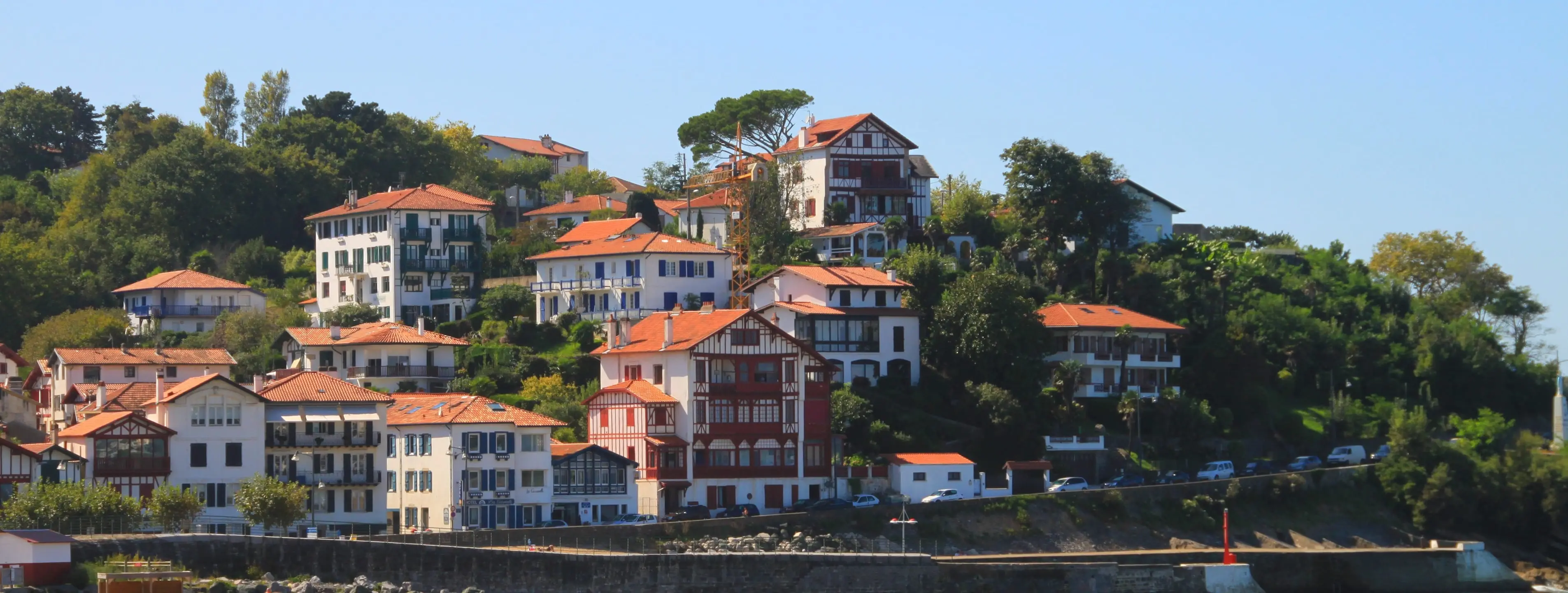
La ville et la falaise, Pays basque
Can the shore be bought?
No: the shore belongs to the public maritime domain (domaine public maritime), which cannot be bought. A beachfront property stops where the shore begins, and anything installed beyond it requires an authorisation.
The shore extends up to the limit of the highest tides, in the absence of exceptional weather disturbances. It is inalienable: no title deed can include it, even when a garden seems to extend into it. And its boundary follows the sea: the part of a plot that the highest tides come to cover falls within the public domain.
Pedestrian access: properties bordering the sea are subject to a public pedestrian right of way over a strip 3 metres wide, with the exceptions provided for by law, notably in the vicinity of houses built before 1976.
The beach: unrestricted, free-of-charge public use is the rule; a house facing the beach has no exclusive right to it.
The jetty, the slipway, the steps down to the sea: on the public domain, they are lawful only under a temporary occupation permit (AOT, autorisation d’occupation temporaire), which is personal, precarious and revocable and does not automatically transfer with the sale.
The mooring: a buoy in front of the house is also subject to authorisation, either an individual one or one within an organised mooring zone.
The harbour berth: as a general rule it depends on the port operator and its waiting list, not on the seller.
Living by the sea all year round or for the season: what changes?
You do not choose the same house by the sea to live in all year round as for a few weeks: out of season, many resorts slow down, and neighbourhood life, services and access then matter more than the view.
Before buying to live there, judge the commune in November, not just in August: shops, doctors, schools, railway station, airport. La Rochelle, Vannes, Saint-Malo, Nice or Biarritz are lived in all year round, as is Sanary-sur-Mer with its village life; other, very residential markets empty out of season.
Seasonal letting: a stricter framework
The law of 19 November 2024 extended registration to all furnished holiday lets (meublés de tourisme), strengthened the tools available to communes and made taxation less favourable. Some coastal communes already regulate such lettings, as Saint-Malo does (see the property finder in Saint-Malo page), and the co-ownership rules (règlement de copropriété) may restrict them: check both before the offer if the letting finances part of the project.
A second home is also subject to the residence tax (taxe d’habitation), which communes in high-demand areas (zones tendues), many of them on the coast, may increase by 5 to 60%. Between your stays, the Home Select concierge service looks after the property, billed for time spent and by quotation, from seasonal openings to the coordination of works.
How do you negotiate a property by the sea?
By the sea, negotiation is won on timing and on proof: the most favourable windows often open out of season, and only precise comparables make it possible to challenge a price that the view appears to justify.
Timing: buyers crowd in during spring and summer; autumn and winter leave less competition, and a property advertised for several seasons has not found its price.
Comparables: a commune’s median says little about a frontline villa; only DVF sales on the same street and of the same type, read alongside the exposure of each address, make an argument.
Works and constraints: a roof, metalwork or drainage to be redone is costed by quotation; a risk zone, an extension that cannot be built or a right of way weigh on the value.
Scarcity: on the most contested properties, the terms (timescales, the date you take possession) matter as much as the price.
On average, Home Select negotiates 6% off the asking price. That is not a promise property by property: a rare, coveted villa leaves little room for negotiation, an overpriced house or one needing renovation more.
How does Home Select search for a property by the sea?
Home Select runs the coastal search remotely, under the direction of its management, and draws on a network of 15,000 professional partners (agents, notaires, managing agents), which brings it at least 100 off-market properties a day, as well as on automated monitoring of 1,700 listing sites.
A first conversation by video call or phone, then a written brief: use, stretch of coast, budget, constraints.
The hunt, and the vetting of each property on documents: planning, the Loi Littoral, the risk report, co-ownership.
A commented video pre-viewing and an analysis sheet for every shortlisted property, the sea-facing façade included; you come only for the decisive viewing.
The price analysed address by address against DVF sales, the negotiation and the securing of the preliminary sale agreement.
Coordination of the notaire, the mortgage broker and the diagnostic surveyors up to the deed, which can be signed remotely, as the guide to buying remotely details.
Two offers, the same full service: the Exclusive offer (exclusive mandate, 2.5% incl. VAT of the net purchase price, minimum €10,000 incl. VAT) covers the whole market, listings and off-market; the Confidential offer (simple mandate, 1.5% incl. VAT, projects of €2m and above) presents off-market properties only. In both cases, 100% on success: nothing is due before the signing of the authentic deed. The detail is on the fees and method pages.
Not always. In coastal communes, the Loi Littoral (coastal law) of 3 January 1986 governs extensions, swimming pools and outbuildings: the 100-metre coastal strip, continuity with existing towns and villages, areas close to the shore. It applies directly to building permits, even on buildable land: have the project reviewed before you buy, and provide for a condition precedent that the authorisation is obtained.
What is the 100-metre coastal strip of the Loi Littoral (coastal law)?
It is the strip of 100 metres, counted from the upper limit of the shore, in which buildings and installations are prohibited outside urbanised areas, except those necessary for public services or for economic activities requiring the immediate proximity of the water. The local urban plan may widen it, and the rule also applies on the shores of lakes of more than 1,000 hectares.
Does a beachfront house come with a private beach?
In principle, no. The shore, up to the limit of the highest tides, belongs to the public maritime domain (domaine public maritime), which cannot be bought, and unrestricted, free-of-charge public use of beaches is the rule. A jetty requires a temporary occupation permit (AOT), which does not automatically transfer with the sale, and properties bordering the sea are in principle subject to a public pedestrian right of way.
How can you tell whether a house by the sea is threatened by erosion or marine flooding?
Read the risk report (état des risques), handed over from the first viewing: it states whether the property falls under a risk prevention plan and, in the communes listed by decree, within a zone exposed to coastal erosion (recul du trait de côte). Géorisques gives a first reading for the address, and the seller must declare in writing the claims paid out for a natural disaster.
Does a sea-view apartment cost much more?
Most often, yes, but the gap is measured street by street. In Nice, among the apartments sold in 2025, a tenth went for less than €2,900/m² and a tenth for more than €7,600/m² (DVF / DGFiP via data.gouv.fr, April 2026 release, 2025 sales): the floor, the exposure and the view explain part of the difference. Check from which rooms the sea can be seen, and what can still be built in front.
How much does a property finder cost for buying by the sea?
Home Select charges 2.5% incl. VAT of the net purchase price on the Exclusive offer, minimum €10,000 incl. VAT, for a search across the whole market, listings and off-market. The Confidential offer, reserved for projects of €2m and above, costs 1.5% incl. VAT, with the same full service, but presents off-market properties only. Nothing is due before the signing of the authentic deed.
Do you have to travel to buy by the sea with Home Select?
In principle only once, for the decisive viewing. Home Select runs the search remotely: brief by video call, checks made on the documents, commented video pre-viewings, price analysis, negotiation. The shortlisted properties are viewed in a single trip: Home Select brings the viewings down to 3 on average, against 40 or more for a buyer on their own, and the deed can be signed by notarial power of attorney.
Your request is already sent, simply pick what suits you.
A property hunter calls you back within the minute.
🇫🇷+33
An error occurred. Please try again.
Then answer 3 quick questions to be matched with the right hunter.
Home Select processes your data (name, email, phone, project) to handle your request and contact you. It is recorded in our follow-up tool and read by the hunter in charge of your project. Our technical providers access it for hosting, email and checking that your email and number are real, some of them from the United States under the safeguards set by the GDPR. We keep it for three years after our last exchange, or five years after the end of our assignment if you entrust it to us, as French anti-money-laundering law requires. To access, correct or erase it, or to object to its use: contact@home-select.fr. Details in our privacy policy.
Your hunter calls you back within the minute.
Resume your request?
You started a request recently. Pick up where you left off, or start over.
Your answers are kept for 24 hours.
What is your project?
Takes 1 minute, no commitment.
Where are you looking?
Select one or more cities or areas
Your budget?
or enter an exact amount
€
You pay only when Home Select finds it.
Anything to add?
Optional. Add any useful details: specifics about your search, constraints or your availability.
This helps your hunter prepare for your call.
An expert will contact you shortly
Your brief
Confidential search: your file goes to a senior hunter.