Where to buy in Brittany: seaside homes from the Emerald Coast to south Finistère, town by town
Brittany has the longest coastline in mainland France, and almost as many property markets as it has bays. This guide tours the coasts where the finest houses are found, from the Emerald Coast to south Finistère: what you can buy, what it costs, how life runs through the year and what to check before you commit.
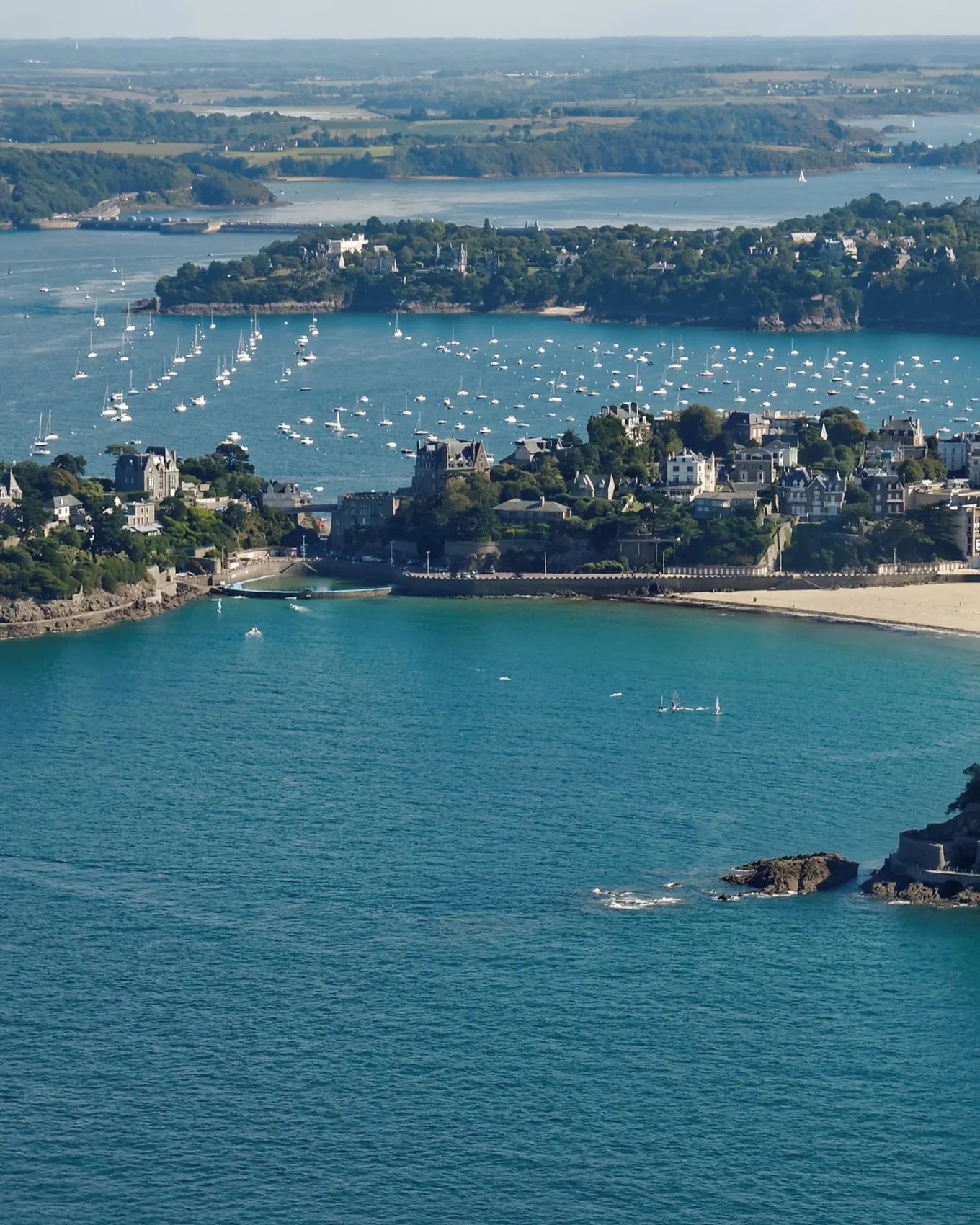
Brittany -Dinard -The headlands and the estuary from the air
By Jean Mascla, founder of Home SelectUpdated · 13 min read
Which part of the Brittany coast should you choose?
Brittany is not one market but a string of very different coastlines. To the north, the English Channel, its huge tides, its Belle Époque resorts and its granite towns; to the south, a gentler Atlantic, sheltered gulfs and long sandy beaches; at the western tip, Finistère, wilder still. The first choice is a way of living with the sea: sailing or beaches, a year-round town or a holiday house.
The Emerald Coast (Côte d’Émeraude): Saint-Malo, Dinard, the malouinières (shipowners’ country houses) of the Clos-Poulet and the Rance estuary, the stretch of coast closest to Paris.
The Gulf of Morbihan: a small inland sea scattered with islands around Vannes, from Arradon to the Rhuys peninsula.
Quiberon Bay: the beaches of Carnac, the harbour of La Trinité-sur-Mer, the Quiberon peninsula.
The Pink Granite Coast: Perros-Guirec and its rose-coloured rocks, at more accessible prices.
South Finistère: Bénodet, Sainte-Marine, Concarneau and the estuaries of Cornouaille, Brittany’s own Cornwall.
To move from a coastline to a property, see buying a seaside house in Brittany, and the Brittany page, which lists the towns we cover and the places we search on request.
Where to buy on the Emerald Coast: Saint-Malo, Dinard, Saint-Briac or Cancale?
Saint-Malo is a real town, lived in all year, with 916 sales over the 12 months to end of June 2026. The walled town (Intra-Muros), rebuilt after 1944, offers apartments in tall granite buildings and a few shipowners’ houses; the Sillon seafront lines up apartments and villas facing the beach; Saint-Servan, on the Rance, is the family neighbourhood. The median for houses reaches €4,400/m², and one house in ten sold above €7,100/m². Behind the town, the Clos-Poulet countryside keeps the malouinières: see buying a house in Saint-Malo.
Dinard, Saint-Lunaire and Saint-Briac-sur-Mer
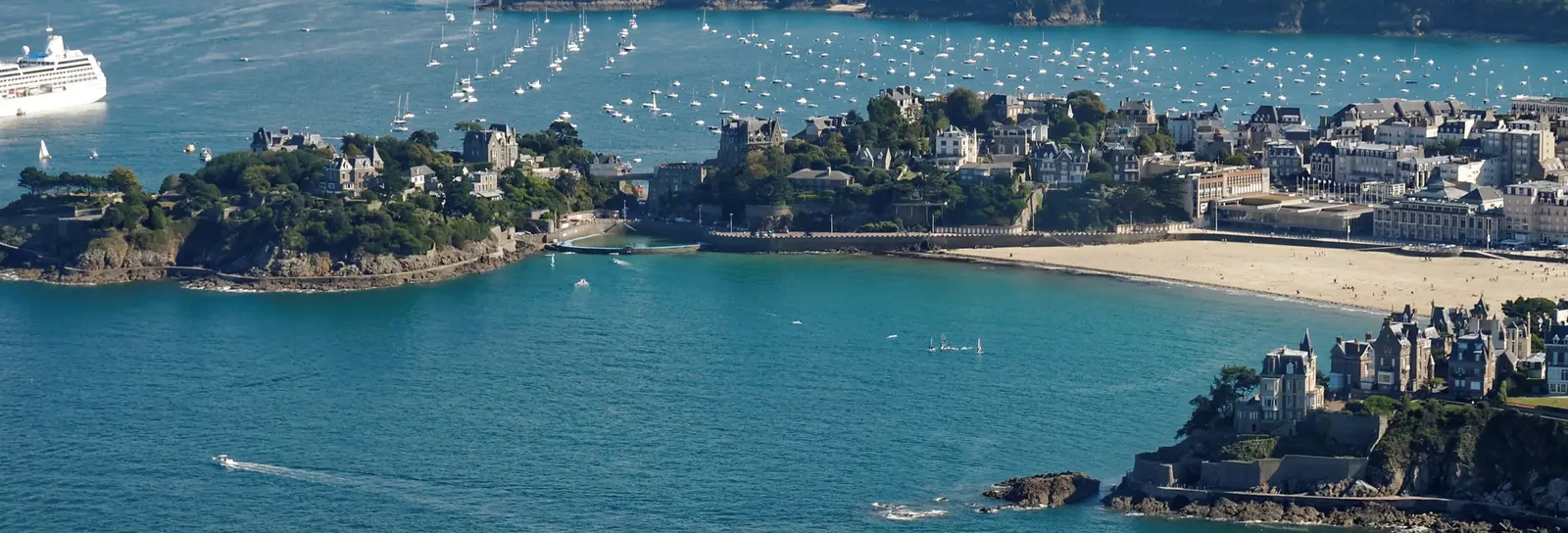
Across the estuary, Dinard was born of a fashion: British and American families built their villas here from the 1860s, and several hundred of them are now protected. The median for houses reaches €4,700/m², one in ten sold above €8,800/m², and the top of the market plays out on the headlands, from the Pointe du Moulinet to La Malouine: see Dinard’s villas. Saint-Lunaire and Saint-Briac-sur-Mer continue the coast on a more intimate scale, with villas, manor houses and a golf course; with 43 sales in a year, Saint-Briac is too thin a market for a reliable median.
Cancale and the Bay of Mont-Saint-Michel
Cancale looks out over the Bay of Mont-Saint-Michel from the port of La Houle and its oyster beds: fishermen’s houses on the harbour, isolated houses towards the Pointe du Grouin. The median for houses stands at €3,600/m², the top decile at €7,000/m². Mind the orientation: on the bay side the sea goes out a very long way, and a high-tide sea view becomes a view of the foreshore. Saint-Malo is fifteen minutes away.
Where to buy on the Gulf of Morbihan?
The Gulf of Morbihan, the “little sea” in Breton, is an inland sea scattered with islands, opening onto the ocean through a narrow channel between Port-Navalo and Locmariaquer, where the currents run hard; the view changes with every tide. At the head of the gulf, Vannes is the administrative capital of the Morbihan, lived in all year round, with its old town, its harbour, its TGV station and a deep market: 999 sales over the 12 months to end of June 2026, a median for houses of €4,100/m² and a top decile of €5,900/m². Within the town, the Conleau peninsula is the sought-after waterside address.
The most sought-after shores lie to the west: the Pointe d’Arradon, Baden and Larmor-Baden facing the islands, Locmariaquer at the mouth of the gulf. Buyers find villas facing the water and longères (long stone farmhouses) in the hamlets, often with a slipway or a mooring. To the south, the Rhuys peninsula (Sarzeau, Arzon, Saint-Gildas-de-Rhuys) has two shores, gulf and ocean, but a single main road. See buying a house on the Gulf of Morbihan and buying a house in Vannes.
Carnac, La Trinité-sur-Mer or Quiberon: which to choose on Quiberon Bay?
On Quiberon Bay, Carnac lives at two tempos: the old town, near the alignments of standing stones, open all year round, and Carnac-Plage, the resort of villas and apartment buildings facing the main beach. It is one of the most expensive markets in Brittany: a median of €5,200/m² for houses and €6,100/m² for apartments, and a top decile for houses of €9,900/m². See buying a villa in Carnac.
La Trinité-sur-Mer is first and foremost a harbour, home port of ocean-racing yachts; the value of its houses lies in the view over the harbour, the Crac’h river or the bay, in a thin market of 53 sales a year. The Quiberon peninsula sets its wild western shore against a sheltered eastern side, and Belle-Île is forty-five minutes away by ferry; the isthmus road jams in summer, so people buy there to stay, not to commute.
What sets the price around the bay
The real view, and from which rooms.
The beach or the harbour on foot, with no need for the car in summer.
The mooring or the berth, which are not sold with the house and often come only after a waiting list.
Why look at the Pink Granite Coast?
On the north coast of the Côtes-d’Armor, Perros-Guirec opens the Pink Granite Coast: the tumbled rocks of Ploumanac’h around the Mean Ruz lighthouse, a protected site, the beach of Trestraou, the coast of Trestrignel and, offshore, the Sept-Îles bird reserve. Neighbouring Trégastel and Trébeurden share the same landscape. Buyers find early twentieth-century granite villas, fishermen’s cottages and neo-Breton houses with a view.
The median for houses stands at €3,200/m², the top decile at €4,800/m², against €2,000/m² across the Côtes-d’Armor: for the same budget, you get more space or a wider view than on the Emerald Coast. Lannion, fifteen minutes away, brings the TGV station and the services of a town. The north coast is windier and cooler than the gulf: people come for the light and the peace, not the heat. See buying a house in Perros-Guirec.
Bénodet and Concarneau: what does south Finistère offer?
Cornouaille is the Brittany of estuaries and pale sandy beaches. Bénodet, at the mouth of the Odet, lines up villas, a marina and beaches facing Sainte-Marine on the opposite bank; the river is lined with manor houses and parks. Concarneau keeps its walled town on an island in the harbour, and its finest addresses on the Pointe du Cabellou. Around them, Fouesnant, Beg-Meil, Loctudy, Névez and Pont-Aven offer village houses, longères and estates on the banks of the rias.
A house in Finistère sells for a median of €2,200/m² (DVF / DGFiP via data.gouv.fr, October 2026 release, 12 months to end of June 2026), but that figure blends inland and coast: a front-line house in Bénodet or on the Cabellou sells well above it, and is valued on its own comparables. Quimper, about twenty minutes away, brings the TGV station, about 3h30 from Paris, and the services of the administrative centre of Finistère. This is the Brittany furthest from Paris, and one of the mildest.
Brittany -Dinard -The headlands and the estuary from the air
How much does a seaside house in Brittany cost?
Recorded sales (DVF, the official record of property sales kept by the French tax authorities) give the measure of each market. For a house, the price per square metre divides the total price, land included, by the built floor area: a large garden or a view pushes it up, renovation work pulls it down. The top decile marks the top of the market; the number of sales, its depth.
Price per square metre (DVF / DGFiP via data.gouv.fr, October 2026 release, 12 months to end of June 2026); sales of apartments and houses. A dash: fewer than 40 sales of that type, too few for a reliable median.
Town
Houses, median
Houses, top decile
Apartments, median
Sales
Saint-Malo
€4,400/m²
€7,100/m²
€4,500/m²
916
Dinard
€4,700/m²
€8,800/m²
€5,300/m²
347
Saint-Briac-sur-Mer
-
-
-
43
Cancale
€3,600/m²
€7,000/m²
€4,300/m²
116
Vannes
€4,100/m²
€5,900/m²
€3,800/m²
999
Carnac
€5,200/m²
€9,900/m²
€6,100/m²
184
La Trinité-sur-Mer
-
-
-
53
Perros-Guirec
€3,200/m²
€4,800/m²
€3,800/m²
177
By department, the median for houses stands at €2,400/m² in Ille-et-Vilaine, €2,500/m² in the Morbihan, €2,200/m² in Finistère and €2,000/m² in the Côtes-d’Armor (DVF / DGFiP via data.gouv.fr, October 2026 release, 12 months to end of June 2026): the gap with the table is the price of the sea.
What is life like on the Brittany coast, all year or by the season?
Since the high-speed line opened in 2017, Rennes has been about 1h30 from Paris, and it makes a good base for those who want a city all year round and the sea at weekends: Saint-Malo is an hour’s drive away. Brittany’s dual carriageways are toll-free; Rennes, Nantes and Brest have European flights, and Saint-Malo and Roscoff have ferries to England, which matters to British buyers.
Indicative times by the most direct trains to the station, not counting the drive.
Where
TGV station
From Paris
Pace of life
Saint-Malo
Saint-Malo
about 2h15
All year
Dinard, Saint-Briac
Saint-Malo, 20 to 25 min
about 2h15
Resort
Cancale
Saint-Malo, 15 min
about 2h15
All year
Vannes and the gulf
Vannes
about 2h30
All year
Carnac, La Trinité
Auray, 15 to 20 min
about 3h
Resort
Perros-Guirec
Lannion, 15 min
just over 3h
All year and seasonal
Bénodet, Concarneau
Quimper, 20 to 30 min
about 3h30
All year and seasonal
The climate is oceanic: mild winters, rare frost by the water, cool summers, frequent but seldom heavy rain, with a sunnier south than the tip of Finistère. Storms matter, as Ciarán showed in November 2023: roofs, trees and joinery need upkeep. Hotter summers in the South of France are also bringing buyers to Brittany in search of cooler air. From October to March, Dinard and Carnac slow right down, while Saint-Malo, Vannes and Quimper keep their services; a house left closed for the winter needs organising: see the empty house in winter.
Malouinière, longère or seaside villa: which house should you buy?
Brittany is built of granite, schist and slate, and prestige here lies mostly in older houses: the coastal law limits new building near the sea.
The malouinière: the country house of Saint-Malo’s shipowners in the seventeenth and eighteenth centuries, in the Clos-Poulet and along the Rance; granite, tall chimneys, a walled park. Several are protected as historic monuments, and their works then go through the state heritage architect (architecte des Bâtiments de France).
The shipowner’s house: a tall granite townhouse in the walled town of Saint-Malo or in Saint-Servan, often divided into apartments.
The seaside villa, from the late nineteenth century to the 1930s: Dinard, Saint-Lunaire, Perros-Guirec, Carnac-Plage, Bénodet. Salt and wind call for a proper survey of the masonry, balconies and joinery.
The longère: a long single-storey rural house of granite or schist, to be renovated with breathable materials; a cement render traps damp in a granite wall.
The fisherman’s house or penty: a small harbour or hamlet cottage, in Cancale or Ploumanac’h, bought for its location more than its size.
The neo-Breton house: white render and a slate roof, built from the 1970s to the 2000s; well placed and with a view, it can be worth more than a poorly located old house.
On all of them, the same checks come back: damp in walls and floors, the slate roof, chimneys, ventilation, joinery exposed to salt, and dry rot (mérule), a fungus of damp timber well known in Brittany. A house rated E, F or G on its energy performance certificate is sold with an energy audit that costs the work, and an oil-fired boiler can no longer be replaced with a new one. See the guide to character houses.
Coastal law, septic systems, radon: which rules apply in Brittany?
Every coastal municipality in Brittany falls under the Loi Littoral, France’s 1986 coastal law, applied strictly here. Outside built-up areas, the 100-metre strip from the shore cannot be built on, extensions included, and new building may only extend existing villages. An existing house can be restored, but an extension, an outbuilding or a pool must be checked before the offer, local plan in hand. The seaside buying guide details the rule and the coastal risks.
The coastal path: a 3-metre public right of way for walkers runs, in principle, along waterfront properties, and the GR34 follows almost the whole coast.
The slipway and the mooring: on the public maritime domain, they need a personal permit that the new owner must apply for again.
The septic system: without mains drainage, the seller provides an inspection report by the local service (SPANC) under three years old, and a non-compliant system must be put right within a year.
Radon: the granite puts much of Brittany in the highest radon-potential zone; a two-month measurement in winter settles the question.
Flooding and erosion: the risk statement, handed over at the first viewing, flags a coastal risk prevention plan or a zone exposed to shoreline retreat.
Protected sites: at Ploumanac’h, on the Pointe de la Garde-Guérin or among Dinard’s villas, protections govern façades, fences and roofs.
Pre-emption: the municipality, the department, the Conservatoire du littoral (the national coastal trust) or the Safer (the rural land agency) can step in ahead of the buyer; see pre-emption rights.
The tax on second homes: many coastal municipalities are classed as tight housing markets and can raise the residence tax (taxe d’habitation) on second homes; see local property taxes.
When to buy in Brittany: the market calendar
Sellers list in spring, and well-placed houses go quickly before the summer. Autumn is often kinder to buyers, once families have made up their minds after one last summer. Winter is the best season to view: the house shows its damp and its low light, and the town shows how it lives out of season.
From accepted offer to final deed: about three months.
After signing the preliminary contract: a ten-day cooling-off period for the buyer.
Urban pre-emption right: two months for the municipality, where it applies.
Notary fees: 7 to 8% of the price for an existing property.
How Home Select searches for a house in Brittany
In Brittany, the finest sea views pass down within families or sell between neighbours. Home Select, a buyer’s agent since 2011, therefore searches by three routes at once: a daily watch, a network of estate agents and notaires along the coast, and direct approaches to owners.
The brief: the coast, your relationship with the water, year-round or seasonal life, the budget including works.
Pre-viewings, on site and by video: you travel only for the decisive visit.
Checks before the offer: planning, septic system, risks, surveys, roof.
Negotiation, based on comparable sales, then support through to the final deed.
Our fees are due on success only, and the search can cover Brittany and Normandy in parallel.
Frequently asked questions
Where should I buy a seaside house in Brittany?
On the Emerald Coast (Saint-Malo, Dinard, Cancale) to be closest to Paris and the Channel ferries; on the Gulf of Morbihan (Vannes, Arradon) for the little inland sea and sailing; in Carnac or La Trinité-sur-Mer for the beaches; on the Pink Granite Coast or in south Finistère for more space for the same budget.
What is the most expensive seaside town in Brittany?
Among the towns we track, the median for houses reaches €5,200/m² in Carnac and €4,700/m² in Dinard. Saint-Briac-sur-Mer and La Trinité-sur-Mer play in the same league, in markets too thin for a reliable median.
Saint-Malo or Dinard: where should I buy?
Saint-Malo is a year-round town, with its TGV station and a deep market (916 sales a year): an apartment in the walled town, a house in Saint-Servan, a malouinière in the Clos-Poulet. Dinard is a resort of villas, quieter in winter. The road over the Rance tidal dam links the two in fifteen minutes.
How much does a house on the Gulf of Morbihan cost?
In Vannes, the median for houses stands at €4,100/m², and one house in ten sold above €5,900/m², against €2,500/m² across the Morbihan. A house facing the gulf, in Arradon, Baden or on the Île-aux-Moines, sits at the top of that range, or beyond.
Can I extend a house near the sea in Brittany?
Rarely freely: outside built-up areas, the coastal law makes the 100-metre strip unbuildable, extensions included, and limits development near the shore. Any extension, outbuilding or pool must be checked before the offer, and the preliminary contract can be made conditional on the planning permission being granted.
Why do septic systems matter so much when buying in Brittany?
Because many houses, on the coast as in the countryside, are not connected to mains drainage. The seller provides the SPANC inspection report under three years old, and a non-compliant system must be put right within a year of the sale: get the quote before the offer, and negotiate on it.
Can you live by the sea in Brittany all year round?
Yes, in a town that lives through the winter: Saint-Malo, Vannes, Concarneau, or near Lannion and Quimper. Dinard, Saint-Briac-sur-Mer, Carnac and Quiberon are much quieter from October to March. The climate is mild; expect storms.
How can I buy a house in Brittany while living abroad?
A notaire authenticates the sale, and the buyer can sign by power of attorney. Home Select runs the search on the ground, sends video pre-viewings and groups the shortlisted properties into a single visit.
Your request is already sent, simply pick what suits you.
A buyer’s agent calls you back within one working day.
🇫🇷+33
An error occurred. Please try again.
Then answer 3 quick questions to be matched with the right hunter.
Home Select processes your data (name, email, phone, project) to handle your request and contact you. It is recorded in our follow-up tool and read by the hunter in charge of your project. Our technical providers access it for hosting, email and checking that your email and number are real, some of them from the United States under the safeguards set by the GDPR. We keep it for three years after our last exchange, or five years after the end of our assignment if you entrust it to us, as French anti-money-laundering law requires. To access, correct or erase it, or to object to its use: contact@home-select.fr. Details in our privacy policy.
Your hunter calls you back within one working day.
Resume your request?
You started a request recently. Pick up where you left off, or start over.
Your answers are kept for 24 hours.
What is your project?
Takes 1 minute, no commitment.
Where are you looking?
Select one or more cities or areas
Your budget?
€
You pay only when Home Select finds it.
Anything to add?
Optional. Add any useful details: specifics about your search, constraints or your availability.
This helps your hunter prepare for your call.
An expert will contact you shortly
Your brief
Confidential search: your file goes to a senior hunter.
60 rue François 1er, 75008 Paris · FCI member
FeesOne month’s rent excluding charges, plus VAT, with a minimum of €2,000 including VAT. Payable only when the lease is signed. No application fee.
Step 1 of 2 · Your search
What are you looking for?
Furnished, unfurnished or both?
In which city?
One or more cities or areas.
€ / month
Charges included, as in the listings.
You would like to move in
Two minutes, no documents needed at this stage.
FeesOne month’s rent excluding charges, plus VAT, with a minimum of €2,000 including VAT. Payable only when the lease is signed. No application fee.
Step 2 of 2 · Your situation
Your situation
These answers let Home Select tell you quickly, and frankly, whether your search can succeed on the market in your city.
You are applying
€ / month
Before tax, regular bonuses included, for everyone applying.
Main applicant’s employment
Your company is based in France
Number of annual accounts filed
To strengthen your file
Optional for your profile. A guarantee reassures landlords.
Guarantor’s situation
€ / month
Who it is for, why you are moving, what matters to you. Do not include sensitive information (health, origin, religion, family situation).
Your contact details
🇫🇷+33
Reply within 24 business hours.
Home Select processes your data (name, email, phone, project, employment, income, guarantee) to review your rental request and contact you. Your answers are compared with the criteria landlords apply, then read by Home Select’s rental hunter. A request that cannot succeed receives a written reply within 24 business hours, and you can ask for it to be reviewed again at contact@home-select.fr. Our technical providers access it for hosting, email and checking that your email and number are real, some of them from the United States under the safeguards set by the GDPR. A request that does not lead to an assignment is erased after three months; otherwise, we keep your data for three years after our last exchange, or five years after the end of our assignment if you entrust it to us, as French anti-money-laundering law requires. To access, correct or erase it, or to object to its use: contact@home-select.fr. Details in our privacy policy.
FeesOne month’s rent excluding charges, plus VAT, with a minimum of €2,000 including VAT. Payable only when the lease is signed. No application fee.
Your file
Your file matches what landlords expect
Book your meeting with Stéphane Martins, rental hunter. He confirms it after reading your file, within 24 business hours.
Choose your time slot
Times shown in Paris time.
Confirmation arrives by email and text message.
FeesOne month’s rent excluding charges, plus VAT, with a minimum of €2,000 including VAT. Payable only when the lease is signed. No application fee.
Your request
Your request is in good hands
Stéphane Martins, rental hunter, is reviewing your file and will reply within 24 business hours.
You will receive a confirmation email.
You arrived through one of Home Select’s ads or campaigns.Ad measurement.Do you agree to Home Select measuring how well it works? Home Select will know which campaign brought you here and, if you get in touch, the ad platform will only learn that its ad worked, without receiving your contact details.Do you agree to Home Select measuring how well its ads work? If you arrive through one of them, Home Select will know which one and, if you get in touch, the ad platform will only learn that its ad worked, without receiving your contact details.Learn moreYour current choice: .