Buying a character home in France, from the bastide to the longère
Buying a character home, or period property, in France means buying an architecture and a history, then an old building and its rules. This guide from Home Select, a property finder (buying agent) on the buyer’s side since 2011, shows you how to recognise the regional house types, judge the price and risks of an unusual property, and negotiate it.
By Jean Mascla, founder of Home SelectUpdated · 15 min read
What is a character home?
A character home is a house, almost always an old one, set apart by its architecture, materials and history: a bastide or a malouinière is not bought by the square metre alone. The term comes from common usage, not from the law: no legal text defines it.
Three signs set it apart from a house that is merely old: a type tied to a region and to the use it served; original materials and craftsmanship (stone, lime, timber, slate, terracotta floor tiles, parquet floors, fireplaces); and a whole that cannot be recreated (grounds, outbuildings, boundary walls, view).
Bastide, mas, échoppe, longère: what are the main regional types of character home?
The main regional types are the bastide and the mas in Provence, the échoppe and the chartreuse (a long, low country residence) in the Bordeaux region, the Basque house and the villa basque, the malouinière and the longère in the west of France, the Belle Époque villa of the seaside resorts, the ferme savoyarde and, in town, the maison de maître and the hôtel particulier (a grand private townhouse).
Provence: the bastide and the mas
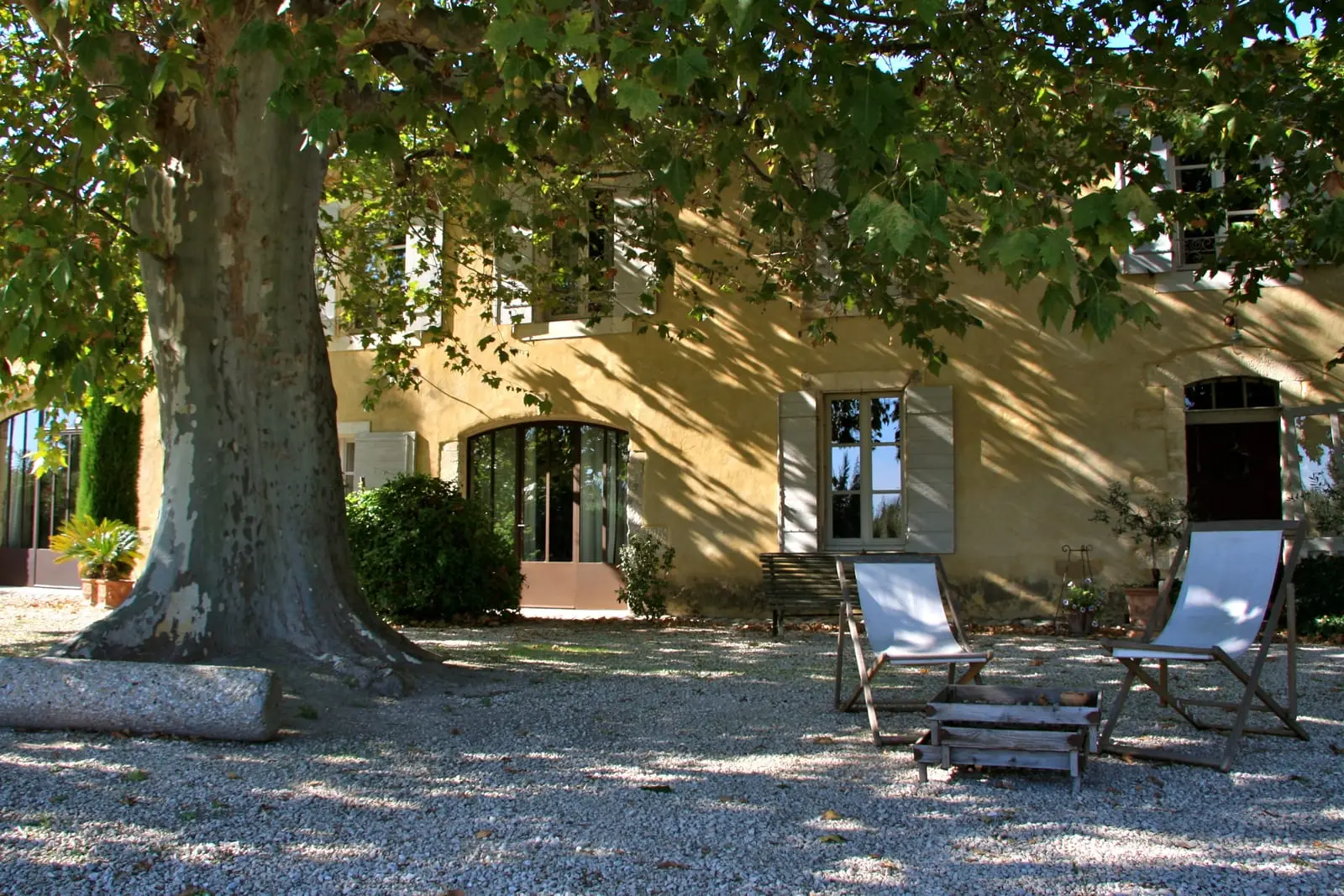
The bastide is the country house of the notables of Aix and Marseille: a symmetrical façade, a génoise (a cornice of stacked round tiles) beneath a roof of round tiles, grounds, often an avenue of plane trees. The mas is the old farmhouse, built lengthways and extended by additions, its main façade facing south and its north façade, with few openings, turned against the mistral. To buy a bastide in Provence, look in particular in the countryside around Aix-en-Provence, whose page on buying a house in Aix-en-Provence details the areas; for a mas, look in the Alpilles, the Luberon or around Avignon.
Bordeaux: the échoppe and the chartreuse
The Bordeaux échoppe is a single-storey stone townhouse, built flush with the street, with a garden at the back: a simple échoppe has its rooms in a row (en enfilade), a double one has them opening onto a central corridor. Its neighbourhoods are described on the page on buying a house in Bordeaux. In the Bordeaux region, the chartreuse is a country residence, often 18th-century, single-storey, long and low, set in grounds or at the heart of a wine estate (château).
Basque Country: the Labourd house and the villa néo-basque
The traditional house of the Labourd, in the French Basque Country, is recognisable by its lime-whitewashed walls, its timber framing and painted shutters, most often dark red or green, and its wide, two-pitched tiled roof, sometimes asymmetrical. Born in the early 20th century, the villa néo-basque (neo-Basque villa) carries these codes over to resort holiday homes: it is found in Biarritz (see buying a villa in Biarritz), in Anglet and in Saint-Jean-de-Luz; the old farmhouses, for their part, lie mostly inland.
Brittany: the malouinière and the longère
The malouinière is the country house built in the 17th and 18th centuries by the shipowners and merchants of Saint-Malo in the Clos-Poulet: a symmetrical façade with granite-framed openings, a high slate roof, large chimneys, grounds often enclosed by walls (see buying a house in Saint-Malo). The longère, a low, elongated rural house built of local stone (granite or schist in Brittany), lines up its rooms beneath a loft; it is found around Vannes as around Saint-Malo, in Normandy and in the Pays de la Loire.
The seaside resorts: the Belle Époque villa
The Belle Époque villa grew out of seaside holidaying: eclectic architecture, turrets, bow windows, verandas. In Dinard, buying a villa often means buying protected heritage; on Normandy’s Côte Fleurie it takes an Anglo-Norman form, half-timbered and brick-built (see buying a house in Deauville); from Nice to Cannes, it stands alongside former palace hotels now divided into apartments. The Ville d’Hiver (Winter Town) of Arcachon keeps its 19th-century villas; the guide to buying by the sea covers the coastal rules.
The Alps: the ferme savoyarde
The ferme savoyarde brought the living quarters, the cowshed and the barn together under a single roof: a masonry base, timber upper floors, a broad overhanging roof. Renovated, it becomes a character chalet, in the hamlets around Megève or Chamonix; the guide to buying in the mountains details the rules that govern its conversion.
In town: the maison de maître and the hôtel particulier
The maison de maître is a bourgeois manor house, in town or village: regular proportions, a symmetrical façade, tall windows, high ceilings, often an enclosed garden. The hôtel particulier is a family’s urban residence, classically built “between courtyard and garden”, the courtyard on the street side behind a carriage gateway (porte cochère); many are now divided into apartments. Aix-en-Provence’s Mazarin quarter, the old centre of Bordeaux, Lyon and Avignon intra-muros (within the ramparts) preserve many of them (see buying a house in Avignon).
What gives a character home its value?
The value of a character home rests on what cannot be reproduced: location, authenticity, volumes, land, outbuildings and view.
Authenticity: original materials and decoration; a heavy, standardised renovation erases it, and part of the value with it.
Volumes: ceiling heights, rooms in enfilade, and attics and cellars that can be converted.
Land and water: area, aspect, trees, a spring, a well or a borehole.
Outbuildings: they are worth what planning rules allow you to do with them.
Surroundings: a bastide overtaken by a housing development loses part of its value.
The medians on this site, drawn from DVF sales (the French register of actual property transactions), divide the price of the whole sale by the built floor area: land, outbuildings and view are all folded into the figure. The gap between the bottom and top deciles measures the real range of a market.
Price per square metre of houses (DVF / DGFiP via data.gouv.fr, April 2026 release, 2025 sales). 10% of sales closed below the bottom decile, 10% above the top decile.
City
Bottom decile
Median
Top decile
Aix-en-Provence
€2,200/m²
€5,300/m²
€8,600/m²
Avignon
€1,500/m²
€2,500/m²
€3,600/m²
Bordeaux
€3,100/m²
€4,800/m²
€7,000/m²
Biarritz
€4,700/m²
€7,900/m²
€14,200/m²
Saint-Malo
€2,700/m²
€4,300/m²
€7,100/m²
Dinard
€2,500/m²
€4,800/m²
€8,100/m²
Vannes
€2,400/m²
€4,000/m²
€5,800/m²
Deauville
€3,400/m²
€6,500/m²
€13,300/m²
A bastide with its grounds, or a malouinière, often has no comparable sale in the year: its price is built on the few sales that resemble it, then adjusted for the condition of the building. Conversely, a house that needs complete restoration can be negotiated below the median. Exceptional properties have their own guide to prestige property.
What should you check in the structure of an old house?
On an old house, five areas concentrate the risk: the roof and roof timbers, walls and damp, floors, utilities and drainage. To these are added wood-boring pests and regulated materials, which the diagnostic reports flag without putting a cost on them; the glossary defines the mandatory diagnostic reports.
Roof, roof timbers and walls
The roof is inspected from the outside and from the loft space: displaced tiles or slates, zinc flashings, gutters, signs of water ingress. The roof timbers are probed, beam ends included: embedded in the masonry, they are the first to rot when the wall is damp, and they weaken the floors they carry. Built without any barrier against rising damp, old walls must be able to dry out: a cement render or a waterproof paint traps moisture inside them, whereas lime lets it evaporate. Saltpetre and peeling render are serious warning signs.
Utilities, heating and drainage
The electrics often have to be redone entirely; the diagnostic report, mandatory for an installation more than 15 years old, gives the measure of the job. An oil-fired boiler already in place can be repaired, but installing a new one has been prohibited since 2022, barring exceptions: when it comes to be replaced, plan for another form of heating. In the countryside, drainage is often private (non-mains): its inspection must be less than three years old, and if it finds the system non-compliant, the works fall to you within the year following the purchase.
Termites, dry rot, lead and asbestos
In the zones delimited by prefectoral order, the seller provides a termite report and information on the risk of dry rot (mérule), a fungus found in damp, poorly ventilated houses. The termite report ignores other wood-boring insects, such as longhorn beetles or woodworm: a broader pest survey can be commissioned. Lead is tested for in homes built before 1949, and asbestos where the building permit predates 1 July 1997: the old fibre-cement sheets of a barn may contain it.
Energy performance certificate (DPE) and energy audit
The energy performance certificate (DPE) rates the house from A to G; a house rated F or G, and since 2025 E, is sold with an energy audit, which sets out costed work scenarios.
What will you be able to change? Heritage protection and planning rules
What you will be able to change depends on the property’s situation, not on its style: protection as a historic monument, the surroundings of a monument, a site patrimonial remarquable and the local urban plan (PLU) can overlap.
Listed (classé / inscrit) historic monument: on a classé building, works require authorisation from the State services; on an inscrit building, they are notified to those services in advance, or subject to their agreement if they require planning permission. Grants and a specific tax regime may attach to it, subject to conditions.
Surroundings of a monument: within the delimited perimeter of its surroundings or, failing that, within a 500-metre radius and within its field of visibility, works that alter the exterior appearance are subject to the agreement of the architecte des Bâtiments de France.
Site patrimonial remarquable: exterior works there are also subject to the agreement of the architecte des Bâtiments de France; the site’s regulations govern façades, roofs, joinery, boundary walls and fences, and colours, and a safeguarding plan (plan de sauvegarde) can protect even interior staircases, panelling or fireplaces.
Local urban plan (PLU): footprint, height, appearance, sometimes prescribed materials and roof pitches; in agricultural or natural zones, extensions and the conversion of a barn into a dwelling are tightly controlled.
The old centre of Honfleur, Avignon intra-muros, the Ville d’Hiver of Arcachon and many villas in Dinard fall under these protections: longer building projects, materials often prescribed, a higher works budget.
Before committing, an operational planning certificate (certificat d’urbanisme opérationnel) tells you whether your project, an extension, a swimming pool or a barn to convert, is feasible. The permits for works already carried out show whether what exists is in order: an extension that was never authorised can complicate your own applications. The preliminary sale agreement (compromis de vente) can include a condition precedent (condition suspensive) covering planning permission.
La cour d'une bastide, Provence
Boundaries, water, neighbours: what should you check around the house?
Around the house, five points are checked before the offer: boundaries, easements, water, the swimming pool and pre-emption rights.
Boundaries: the cadastral plan is a tax document and does not prove the boundaries; an agreed boundary survey (bornage contradictoire), drawn up by a géomètre-expert (a chartered land surveyor), fixes them.
Easements: a right of way, a pipe, a power line, a right of view; the title deed lists those that are written down, and the land sometimes reveals others. A party wall, whether of a house or of a boundary, is maintained at shared cost.
Water: a domestic well or borehole must be declared at the town hall; in the Aix area, a bastide is also judged by its connection to the Canal de Provence.
Swimming pool: a private in-ground swimming pool must have a standardised safety device (law of 3 January 2003).
Pre-emption rights: the rural land agency, SAFER, which holds a pre-emption right, may exercise it on certain rural properties (farmland and farm buildings, sometimes the old farmhouse itself); the commune, where it has instituted its urban pre-emption right (droit de préemption urbain), has two months to respond to the declaration of intention to sell (déclaration d’intention d’aliéner).
That leaves the neighbourhood: livestock farming, a road, a quarry or a wind-farm project can change life in an isolated house. The PLU tells you what can be built around it; the risk report (état des risques), which natural and technological hazards the land is exposed to.
How much should you budget for works and energy renovation?
The budget for a character home adds together the price, the acquisition costs (commonly called “notary fees”), around 7 to 8% on existing homes, and works that are almost always needed, to be costed from quotes before the offer. No per-square-metre ratio replaces a visit from the building trades.
Read the diagnostic reports and, where applicable, the work scenarios in the energy audit.
Have the major items costed by those who will carry them out; consult an architect as soon as the project touches a protected area.
Keep a reserve for the unforeseen, which is more frequent in old buildings than in new ones.
Check the available grants before signing a quote: most must be applied for before the works begin.
Fix the timetable: processing of the authorisations, availability of heritage artisans, seasons.
MaPrimeRénov’ (the State renovation grant) and the éco-prêt à taux zéro (the interest-free eco-loan) are aimed at homes occupied as a main residence: a second home does not in principle qualify. The conditions and amounts of these schemes change often: check them at the time of your project with France Rénov’, the public service for home renovation.
Old buildings are renovated case by case: a vapour-tight insulating material fitted against a stone wall can trap moisture in it. The loft and the heating are generally the first levers; insulating façades from the outside is often ruled out in a protected area.
How do you negotiate an unusual house?
An unusual house is negotiated on three levers: genuinely comparable sales, the costed price of the works, and time.
DVF sales are public, with their price, floor area and address: you search them for the two or three sales that genuinely resemble the property, rather than for a median. The top decile, €11,300/m² for houses in Arcachon or €9,900/m² on the Île de Ré (DVF / DGFiP via data.gouv.fr, April 2026 release, 2025 sales), marks the top of the ordinary market; beyond it, every property is a case of its own.
Time counts as well: a price set out of attachment to the house sometimes leaves it on the market for a long time, and a property held in joint inheritance ownership (indivision) can in principle be sold only with the agreement of all the joint owners, which lengthens the timeline and lets expectations change.
The negotiation also covers the date, the furniture, and the conditions precedent relating to a loan or to planning permission. Across all its searches, Home Select obtains 6% off the asking price on average: an average, not a guarantee.
How Home Select searches for a character home
Home Select searches for character homes and period properties for sale in France on the buyer’s side only, across the whole market, listings included and beyond: bastides, malouinières and maisons de maître often change hands through inheritance, through the family notaire (the public officer who draws up the deed) or through personal connections, before any listing (see the guide to buying an off-market property).
Home Select runs the search under the direction of its management and draws on a network of 15,000 professional partners, who bring it at least 100 off-market properties every day, and on monitoring of 1,700 listing sites. The search is conducted remotely: the brief drawn up on a video call, qualification from the documents, a commented video pre-viewing and an analysis sheet for every property shortlisted, the price compared with DVF sales, negotiation, securing the compromis, and coordination of the notaire, the mortgage broker and the surveyors. You travel only for the decisive viewing, grouped into a single trip (the method).
With the Exclusive offer, Home Select charges 2.5% of the net purchase price, minimum €10,000 incl. VAT; for a project of €2m and above, the Confidential offer, at 1.5% under a simple mandate, presents off-market properties only, with the same full service. Nothing is due before the purchase: 100% on success, at the signing of the authentic deed (acte authentique) (the fees). Founded in 2011, Home Select has guided more than 1,200 buyers and has a 4.8/5 rating on Google (130+ reviews).
What is the difference between a bastide and a mas?
In Provence, the bastide is the country house of the notables of Aix and Marseille: a symmetrical façade, a génoise (a cornice of stacked round tiles) under the roof, grounds, often an avenue of plane trees. The mas is a former farmhouse, built lengthways and extended by additions, open to the south and shut against the mistral.
What is a Bordeaux échoppe?
The Bordeaux échoppe is a single-storey stone townhouse, built flush with the street with a garden at the back, typical of Bordeaux and its inner suburbs. A simple échoppe has its rooms in a row (en enfilade); a double one arranges them on either side of a central corridor. Before buying, check for damp in the walls, for cracks if the ground is clay, and for what the local urban plan (PLU) allows for extending.
What is a malouinière?
A malouinière is a country house built in the 17th and 18th centuries by the shipowners and merchants of Saint-Malo in the Clos-Poulet: a symmetrical façade with granite-framed openings, a high slate roof, large chimneys, grounds often enclosed by walls. Few are sold, and rarely through a listing: buying one has to be prepared well in advance.
What should you check before buying a longère?
The longère, the low, elongated old stone house of rural Brittany, Normandy and the Pays de la Loire, is checked on four points: what the local urban plan allows for extending it or converting the loft, the compliance of private drainage, damp in the walls and, in the zones delimited by prefectoral order, the risk of dry rot (mérule).
Maison de maître (manor house) or hôtel particulier (grand townhouse): what is the difference?
The maison de maître is a bourgeois manor house, in town or village, with regular proportions, a symmetrical façade and high ceilings. The hôtel particulier is a family’s urban residence, classically built between courtyard and garden; divided into apartments, it is bought as co-ownership lots, with the co-ownership regulations and service charges.
What is a villa basque?
The villa basque, or villa néo-basque (neo-Basque villa), carries the codes of the traditional Labourd house over to resort holiday homes: lime-whitewashed walls, timber framing and painted shutters, most often dark red or green, a wide two-pitched tiled roof. Born in the early 20th century, it is very present in Biarritz, Anglet and Saint-Jean-de-Luz; before the offer, the timberwork, the roof and the lawful status of any extensions are checked.
How much does a property finder cost for a character home?
Home Select applies the same fees to a character home as to any search: 2.5% of the net purchase price with the Exclusive offer, minimum €10,000 incl. VAT, or 1.5% with the Confidential offer, the same service reserved for projects of €2m and above and limited to off-market properties. Nothing is due before the purchase: 100% on success, at the signing of the authentic deed.
Your request is already sent, simply pick what suits you.
A property hunter calls you back within the minute.
🇫🇷+33
An error occurred. Please try again.
Then answer 3 quick questions to be matched with the right hunter.
Home Select processes your data (name, email, phone, project) to handle your request and contact you. It is recorded in our follow-up tool and read by the hunter in charge of your project. Our technical providers access it for hosting, email and checking that your email and number are real, some of them from the United States under the safeguards set by the GDPR. We keep it for three years after our last exchange, or five years after the end of our assignment if you entrust it to us, as French anti-money-laundering law requires. To access, correct or erase it, or to object to its use: contact@home-select.fr. Details in our privacy policy.
Your hunter calls you back within the minute.
Resume your request?
You started a request recently. Pick up where you left off, or start over.
Your answers are kept for 24 hours.
What is your project?
Takes 1 minute, no commitment.
Where are you looking?
Select one or more cities or areas
Your budget?
or enter an exact amount
€
You pay only when Home Select finds it.
Anything to add?
Optional. Add any useful details: specifics about your search, constraints or your availability.
This helps your hunter prepare for your call.
An expert will contact you shortly
Your brief
Confidential search: your file goes to a senior hunter.