Moving out of Île-de-France: choosing your city and buying in the French regions
Moving from Paris to the French regions means, above all, buying: a city to choose, a market to read, a sale and a purchase to sequence. Home Select, a property finder (buyer’s agent) working on the buyer’s side since 2011, sets out in this guide the criteria, the prices and the timetable.
By Jean Mascla, founder of Home SelectUpdated · 15 min read
Why is moving out of Paris first and foremost a buying decision?
Because the move itself takes a day, whereas the purchase commits you for years: the city, the neighbourhood and the property you choose decide the life you will lead once you have left Paris. A purchase is hard to undo, since acquisition costs are rarely recovered on a quick resale.
Settling in the French regions therefore starts with three questions, asked before you look at a single listing.
What working life? Full-time remote working, a week split with Paris or a job on the spot: each answer draws a different map.
What family life? The children’s ages decide which school you need nearby: primary school, collège (lower secondary school) or lycée (upper secondary school).
What horizon? A permanent move, a trial of a few years or preparing for retirement call for neither the same city nor the same property.
If you are torn between two cities, renting for a year before buying remains a serious option, at the cost of rent and one more move. Buying a second home first in the city you have in mind, to settle there later, is another: the guide to buying a second home sets out the budget.
How do you choose where to live in France when you leave Paris?
The right city is chosen on six criteria, in this order: work, access, schools, health care, pace of life, then the property market. Price comes last, because it can be compared and negotiated, whereas a badly chosen city can only be put right by selling.
Work: if you work from home part of the week, the station matters more than the city, with a direct high-speed (TGV) link to Paris and timetables that suit the days you have to be on site; if your partner is looking for a job locally, the local job market weighs just as much.
Access: Lyon, Bordeaux, Marseille, Toulouse and Nice are served by an international airport; Annecy and Évian-les-Bains benefit from Geneva airport; in Aix-en-Provence as in Avignon, the TGV station lies away from the town centre, although Avignon also has a central station. Check the journey to your future address.
Schools: state primary schools and collèges are in principle assigned by address, and the school catchment rules should be checked before the offer: with the town hall for the primary school, with the département (county authority) or the local education authority for the collège.
Health care: access to a hospital, to specialists and to a regular GP (médecin traitant) varies greatly from one area to another.
Pace of life: climate, culture, sport, sea or mountains; whatever makes you leave Paris has to be there all year round.
Finally, the market is read by its depth as much as by its price: the number of sales a year gives the order of magnitude of the properties you will see come up. In 2025, 7,165 sales of apartments and houses were recorded in Lyon, against 149 in Honfleur (DVF / DGFiP via data.gouv.fr, April 2026 release, 2025 sales). On a narrow market, the property that suits you may come up only a few times a year: the search takes more patience there, and so does the resale.
Big city, human-scale town or coast: where in the French regions should you look?
It is often your work that decides between three ways of leaving: the big city, to change city without changing professional pace; the human-scale town, whose centre you can live in on foot; the coast, to live by the sea.
Big cities: a job market, a station, an airport
Lyon, Bordeaux, Toulouse, Montpellier, Nice and Marseille each have a deep job market, a university, a university hospital and a TGV station, and all are served by an airport. Their property market is first of all one of apartments, although Bordeaux also offers, within the city itself, its échoppes, those low stone houses. Aix-en-Provence, in the Aix-Marseille-Provence metropolis, adds an old town centre and a countryside of bastides (Provençal country houses).
Human-scale towns: the centre on foot, Paris by TGV
La Rochelle, Annecy, Vannes and Avignon share a centre where daily life is lived on foot, a TGV link with Paris and houses with gardens within the town itself. The job market is narrower there than in the big cities: these towns suit remote working first, or work that travels with you, and Annecy also has cross-border commuters who work in Geneva. The pages on the property finder in La Rochelle and the property finder in Vannes detail two of them, neighbourhood by neighbourhood.
The coast: living all year round where you used to spend the summer
Arcachon, Biarritz, Saint-Jean-de-Luz, Saint-Malo or Antibes, at the gates of the Sophia Antipolis technology park, are chosen for the sea; to live there all year round, look at the services too: Saint-Malo, for example, has its lycées, its hospital, its port and its TGV station.
In Home Select’s experience, a sea view and proximity to the water come at a premium there, on narrower markets than in the big cities, as the page on the property finder in Biarritz shows; the guide to buying by the sea details the Loi Littoral (coastal law) and coastal risks.
Whether you are relocating from Paris to the Atlantic coast or to Provence, the Atlantic Coast and Provence pages compare the cities of each region, prices included.
How much does property cost in the French regions, city by city?
In the French regions, the median for apartments is, for example, €2,300/m² in Avignon and €7,000/m² in Biarritz (DVF / DGFiP via data.gouv.fr, April 2026 release, 2025 sales), against a benchmark of €9,900/m² median in Paris (DVF, April 2026 release).
Median prices per m² and sales of apartments and houses (DVF / DGFiP via data.gouv.fr, April 2026 release, 2025 sales). Benchmark: €9,900/m² median in Paris (DVF, April 2026 release). Market benchmarks, never the valuation of a property.
City
Apartments (median)
Houses (median)
Sales in 2025
Lyon
€4,400/m²
€5,300/m²
7,165
Bordeaux
€4,100/m²
€4,800/m²
4,820
Toulouse
€3,200/m²
€3,700/m²
8,268
Montpellier
€3,400/m²
€3,700/m²
4,719
Marseille
€3,200/m²
€4,600/m²
12,578
Aix-en-Provence
€4,800/m²
€5,300/m²
2,293
Nice
€4,800/m²
€5,700/m²
7,826
Annecy
€5,100/m²
€5,900/m²
1,814
La Rochelle
€4,800/m²
€4,300/m²
1,460
Vannes
€3,900/m²
€4,000/m²
1,028
Avignon
€2,300/m²
€2,500/m²
1,516
Saint-Malo
€4,500/m²
€4,300/m²
859
Arcachon
€7,400/m²
€7,600/m²
490
Biarritz
€7,000/m²
€7,900/m²
781
A median splits the sales into two equal halves: it places a market, not a property. In Biarritz, a tenth of houses sold for less than €4,700/m² and a tenth for more than €14,200/m² (DVF / DGFiP via data.gouv.fr, April 2026 release, 2025 sales): the address, the view and the condition set the price.
The area you search matters too: in Arcachon, the median for apartments is €7,400/m², against €3,800/m² for the Gironde département as a whole. A neighbouring commune and a property to renovate are both budget levers in their own right.
On top of that come the acquisition costs (commonly called “notary fees”), around 7 to 8% of the price on existing homes and 2 to 3% on new-build, which the notary fees calculator works out for you, and the property tax (taxe foncière), which varies widely from one commune to another: ask the seller for the latest notice.
Selling in Île-de-France and buying in the regions: in what order?
Three approaches exist: selling first, buying first with the help of a bridging loan, or timing the two transactions so that the deed of sale comes shortly before the deed of purchase. The right choice depends on your down payment, on how easily your Île-de-France property will sell and on how tight the target market is.
A bridging loan advances part of the price expected from your sale, for a limited period.
Approach
What it protects
What it costs
When to choose it
Selling first
A known budget, an offer with no condition tied to your sale
Temporary housing, sometimes an extra move
The property you want is rare and goes quickly
Buying first, with a bridging loan
The property you have found, without waiting for your sale
The interest on the bridging loan, the risk of selling later or for less
Your down payment is solid and your Île-de-France property is easy to sell
Aligning the two deeds
A single move, with no temporary housing
Tight coordination of the notaires (the public officers who draw up the deeds) and of the dates
The sale and the purchase are moving at the same pace
Aligning the two deeds means knowing the timescales between the preliminary sale agreement (compromis de vente) and the authentic deed: a ten-day cooling-off period for a non-professional buyer, a mortgage condition precedent of a month at minimum by law, often 45 to 60 days in practice, and, where it applies, the two months the commune has to exercise its pre-emption right. The date of the deed, set in the preliminary sale agreement, then lines up with your sale. A condition precedent tied to the sale of your own property remains possible, but it weakens your offer.
Sell or keep your Île-de-France home?
Sold as your main residence, your home is not subject to capital gains tax. If you move out before selling, the tax authority lets you keep the capital gains tax exemption, provided that the property is put on the market without delay, sold within a normal period and neither let nor lent in the meantime: have your notaire confirm this timetable.
Kept, to be let or as a pied-à-terre, it loses this exemption: its capital gain will in principle be taxable on resale, with allowances for length of ownership that the capital gains calculator lets you anticipate. Let out, it must have an energy performance certificate (DPE) rating that allows it: G-rated homes have been barred from new lettings since 2025, F-rated homes will be in 2028 and E-rated homes in 2034. As a pied-à-terre, it bears the housing tax on second homes (taxe d’habitation sur les résidences secondaires), which communes in high-demand areas (zones tendues), Paris among them, may raise by 5 to 60%.
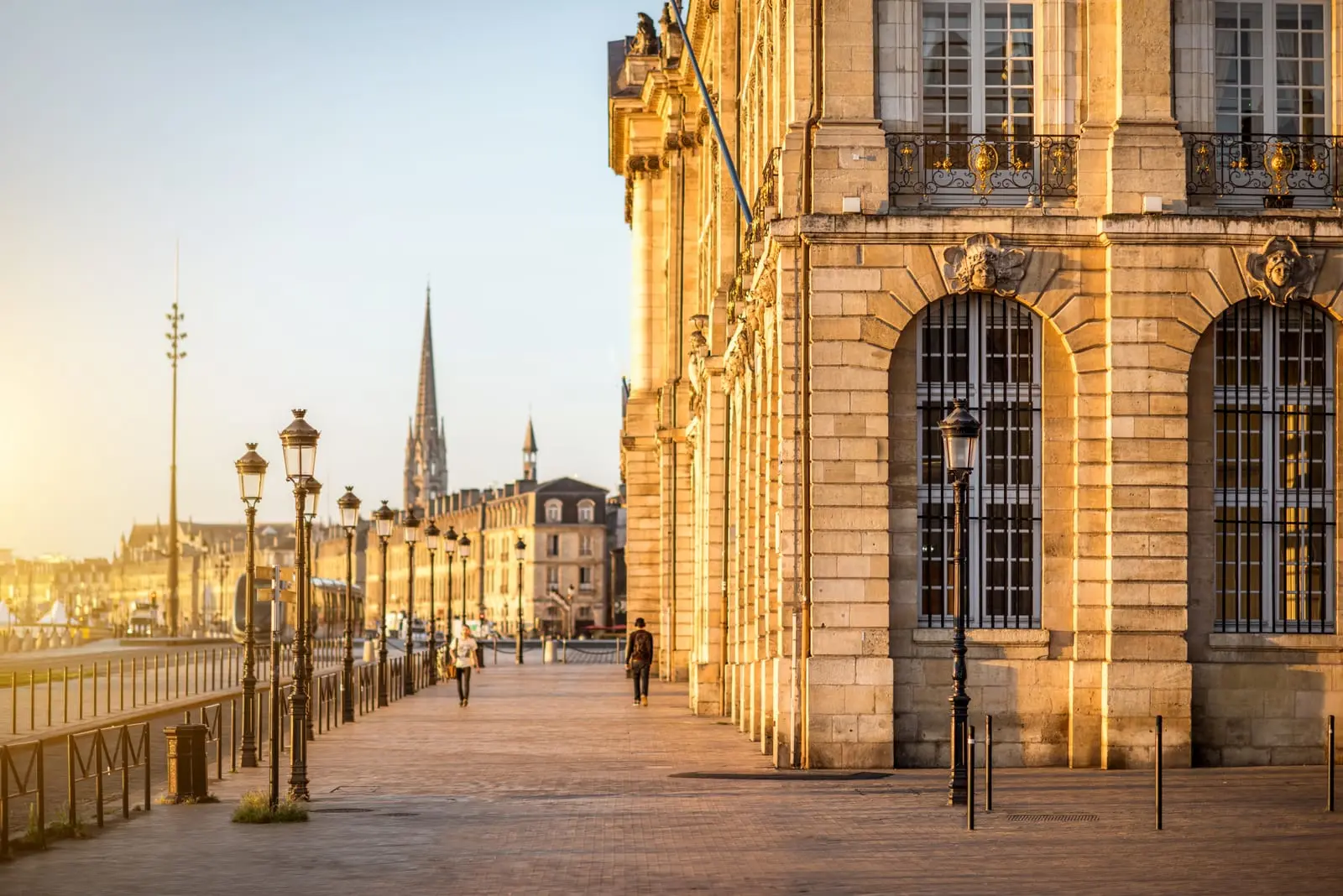
Les quais de la Garonne, Sud-Ouest
How do you finance a purchase in the French regions when you are changing your life?
By having the financing validated on the situation you will have after the move, not on the one you are leaving. Banking rules are national: a debt-to-income ratio of 35% at most, insurance included, and a term of 25 years at most as a general rule; in 2026, rates stand between 3.2 and 3.5% over 20 years.
A change of job needs to be prepared with the bank: a probationary period still running can delay the loan approval.
If you own your home, the proceeds of selling your Île-de-France property, net of the outstanding mortgage, make up the down payment: value that property on the actual sales in your street, and set aside part of the down payment for acquisition costs, works and any temporary housing.
A mortgage broker gets the banks competing and puts the application together; when Home Select runs the search, it coordinates the broker and the notaire on the timetable of the mortgage condition precedent.
How do you search in the French regions from Paris without spending your weekends there?
By running remotely everything that comes before the decisive viewing, the only one you travel for: that is how Home Select works outside Île-de-France.
The alternative is Saturdays spent travelling back and forth and viewings scattered between agencies: a buyer searching alone makes 40 viewings or more on average, over six months and about 150 hours; Home Select brings the search down to three viewings, 45 days to an accepted offer and about 15 hours on average.
The brief, by video call or phone: cities, neighbourhoods, type of property, budget, deal-breakers, the timetable for your sale.
The hunt across the whole market, listings, network and off-market properties: search launched within 24 hours of the brief, first proposals within 48 hours of the mandate being signed.
Vetting on the documents: floor plans, diagnostic reports, risk report (état des risques), minutes of the co-owners’ general meetings, property tax, planning rules.
The commented video pre-viewing, with an analysis sheet for every property shortlisted and its price set against DVF sales, address by address.
The decisive viewing, with the shortlisted properties grouped into a single trip.
The offer, the negotiation, securing the compromis, then the deed, which can be signed remotely by a notarial power of attorney taken by video call, or at a notaire near where you live.
Video has its blind spots, which the decisive viewing is there to clear: noise, smells, light, the neighbours. The guide to buying remotely details each step. Before the deed, funds go only to the notaire, once you have checked their bank details by telephone.
What are the most common mistakes when leaving Paris?
The most common mistakes are made before the offer: a city chosen on holiday, a market read through Parisian eyes, a house badly checked.
Choosing the town you know from your holidays: you knew it without school, commuting or work, yet that daily life is exactly what you are buying there.
Underestimating seasonality: on the coast, some houses open up only in summer and your street may be empty in winter; in Home Select’s experience, competition between buyers is also weaker there out of season.
Judging prices through Parisian eyes: a property is compared with the sales on its own street, not with the apartment you are leaving.
Ignoring how narrow the market is: where sales are counted in the hundreds, buy a property that will appeal to others too, because that is the one that will resell.
Forgetting the car: outside town centres, one car, sometimes two, often becomes necessary; check parking and the distance to the station at the address itself.
Buying too big: a plot, a swimming pool or an outbuilding all have to be maintained, and that upkeep should be costed before the offer.
Your first house after an apartment: what else to check
Buying a house outside Paris after an apartment means answering alone for what the co-ownership used to manage for you: the roof, the walls, the utilities. All of this needs checking before the offer.
Non-mains drainage (assainissement non collectif): where there is no connection to the mains sewer, an inspection less than three years old, and works within the year following the sale if the installation does not comply.
The structure: roof, roof timbers, walls and damp, to be assessed by a professional.
Termites and dry rot (mérule), in zones set by prefectoral order.
The DPE and, for a house rated F or G (since 2023) or E (since 2025), the energy audit that is mandatory on sale.
An in-ground swimming pool, which must have a standardised safety device (law of 3 January 2003).
The plot: boundary survey (bornage), easements and planning rules if you intend to extend.
How Home Select supports a move out of the Paris region
Home Select takes charge of the search in the regions from start to finish, so that you can keep your current life going until the decisive viewing. A property finder founded in Paris in 2011, Home Select works only for the buyer: never a sales mandate on a property it presents, never a commission from the seller.
In the regions, Home Select runs the search through its management and draws on its network of 15,000 professional partners, who bring it at least 100 off-market properties a day, and on the monitoring of 1,700 listing sites. Home Select then negotiates for you and obtains an average of 6% off the asking price, before securing the compromis and coordinating the notaire, the mortgage broker and the surveyors; support continues after the deed, through to settling in.
The fees are published and identical from one region to the next: 2.5% of the net purchase price, the price paid to the seller excluding the agency commission, on the Exclusive offer, minimum €10,000 incl. VAT, or 1.5% on the Confidential offer, reserved for projects of €2m and above and devoted to off-market properties only, for the same service under a simple mandate. Both offers are paid 100% on success and nothing is due before the authentic deed: see the details of the fees and of the method. A city without a page on this site is handled on a tailor-made basis, with the same method.
Frequently asked questions
What are the best places to live in France outside Paris?
There is no single best city: it is chosen on work, access by train and plane, schools, health care and budget. Lyon, Bordeaux or Toulouse offer a job market, a TGV station and an airport; La Rochelle, Annecy, Vannes or Avignon, a centre where daily life is lived on foot and the TGV to Paris; the coast, from Saint-Malo to Antibes, the sea all year round.
Moving from Paris to the French regions: where do you start?
With your plans for your life, not with the listings: your working pattern, the children’s schooling, your horizon. Then shortlist two or three cities, spend a weekday in each out of season and have your financing validated on your future situation. Finally, fix the order of the sale and the purchase before the first offer.
Do you have to sell before buying when you leave Île-de-France?
Not necessarily. Selling first fixes your budget and strengthens your offer, at the price of temporary housing. Buying first, with a bridging loan, secures the property you have found, at the price of the loan’s interest and a risk on your sale. Aligning the two deeds a few days apart avoids these drawbacks, but demands tight coordination between the notaires.
How much does property cost in the French regions compared with Paris?
The benchmark is €9,900/m² median in Paris (DVF, April 2026 release). In the French regions, the median for apartments is €4,400/m² in Lyon, €4,100/m² in Bordeaux and €3,200/m² in Toulouse; for houses, it is €7,900/m² in Biarritz and €7,600/m² in Arcachon (DVF / DGFiP via data.gouv.fr, April 2026 release, 2025 sales). The price of a given property, though, is judged on the sales in its own street.
Should you keep a pied-à-terre in Paris after you leave?
It is possible, but it has to be costed. A home you keep bears the housing tax on second homes (taxe d’habitation sur les résidences secondaires), which Paris, a commune in a high-demand area (zone tendue), may increase. Above all, it loses the main-residence exemption: its capital gain will in principle be taxable on resale, after allowances for length of ownership. Compare that cost, service charges and property tax included, with the cost of hotel nights.
How long does it take to find a property in the French regions with a property finder?
Home Select takes 45 days on average to reach an accepted offer, with three viewings for the client, against 40 viewings or more and six months for a buyer searching alone. First proposals arrive within 48 hours of the mandate being signed. On a narrow market, a very precise brief may take more patience.
How much does a property finder cost for a purchase in the French regions?
Home Select charges 2.5% of the net purchase price on the Exclusive offer, minimum €10,000 incl. VAT, or 1.5% on the Confidential offer, reserved for projects of €2m and above: the same service as the Exclusive offer, devoted to off-market properties only. The fees are due 100% on success, at the signing of the authentic deed: no advance and no file fee, as the Loi Hoguet, the French law that regulates property professionals, requires. The rates are identical from one region to the next.
Your request is already sent, simply pick what suits you.
A property hunter calls you back within the minute.
🇫🇷+33
An error occurred. Please try again.
Then answer 3 quick questions to be matched with the right hunter.
Home Select processes your data (name, email, phone, project) to handle your request and contact you. It is recorded in our follow-up tool and read by the hunter in charge of your project. Our technical providers access it for hosting, email and checking that your email and number are real, some of them from the United States under the safeguards set by the GDPR. We keep it for three years after our last exchange, or five years after the end of our assignment if you entrust it to us, as French anti-money-laundering law requires. To access, correct or erase it, or to object to its use: contact@home-select.fr. Details in our privacy policy.
Your hunter calls you back within the minute.
Resume your request?
You started a request recently. Pick up where you left off, or start over.
Your answers are kept for 24 hours.
What is your project?
Takes 1 minute, no commitment.
Where are you looking?
Select one or more cities or areas
Your budget?
or enter an exact amount
€
You pay only when Home Select finds it.
Anything to add?
Optional. Add any useful details: specifics about your search, constraints or your availability.
This helps your hunter prepare for your call.
An expert will contact you shortly
Your brief
Confidential search: your file goes to a senior hunter.