Looking after a garden in France from abroad: the calendar, the contracted gardener, checked watering
The garden is the part of a property that changes fastest: a single season with nobody there is enough to turn it into a building site. Keeping it from abroad rests on three decisions: a minimum plant calendar kept all year, a local gardener bound by a written scope with photos at every visit, and automated but checked watering. This dossier details each one.
By Jean Mascla, founder of Home SelectUpdated · 8 min read
What does a garden become in one season with nobody there?
The neglected-garden storyline nearly always unfolds the same way. In spring, the lawn takes a week’s head start and soon passes ankle height: at that stage, mowing becomes a job that strains both machine and turf. Boundary shrubs grow towards the facade, rub the walls with every wind, hold moisture against the render and eventually block the windows. The previous autumn’s leaves rot in the gutters, and the first rain overflows down the walls.
There is something quieter but heavier: buried irrigation. A blocked sprinkler kills the patch it was meant to serve, while a micro-leak at a hidden joint soaks the ground and swells the water bill for months. And there is the social signal, always underestimated. A visibly abandoned garden tells the whole street the house is empty: it worries the neighbours, drags down the look of the area and, in some communes, eventually triggers a formal reminder from the town hall about upkeep of the land.
The calendar speeds everything up. A lawn ignored for a month becomes a meadow to clear; a hedge left alone for a season needs a corrective trim that disfigures it; a sick shrub left untreated infects its bedfellows. Conversely, a tended garden asks little: each visit deals with what has grown since the previous one, and nothing piles up. That is the whole difference between maintaining and catching up.
Put plainly: garden maintenance is not an aesthetic question. It is a question of protecting the property, the neighbourhood and your security.
The minimum plant calendar, season by season
There is no need to aim for a show garden. A tight calendar, honoured every year, is enough to keep a garden alive and the neighbours reassured. Here it is as a set of markers, to be adjusted to your region and soil.
Season
Task
Indicative frequency
Spring
First mow of the season, first shaping prune of shrubs
Throughout the season, firm rhythm
Summer
Regular mowing, watering, watching young plantings
Frequent mowing if growth allows
Autumn
Leaf clearing, hedge trimming, tidying paths
One to two visits
Winter
Pruning of large specimens and fruit trees, draining the irrigation
One visit, outside frost
All year
Visual check of the garden and watering equipment
At every visit to the property
Two useful details complete this table. The hedge, first: its growth is steered with the summer and autumn trims, two appointments that keep a clean boundary with the neighbouring plot, a classic source of dispute when you are away. Climbing plants next: wisteria, ivy, Virginia creeper creep discreetly along the gutters and under the eaves; a firm annual cut keeps their progress under control, and the visual check at every visit makes sure they are not climbing any higher.
Two markers deserve emphasis. First the pruning of boundary shrubs: keeping them off the facade is worth twice its cost, since it protects both the render and the gutters. Then draining the irrigation before winter: a buried pipe full of water is a pipe at risk of splitting in frost, exactly like a house pipe.
Contracting with a local gardener
This is the heart of the matter when you live abroad: you cannot supervise, so everything must be written down. A verbal arrangement with the village gardener lasts a spring, rarely two seasons.
The written scope describes every expected task, without ambiguity:
mowing and clippings removal, desired cutting height;
hedge and shrub trimming, with green-waste disposal specified;
weeding of paths, agreed method;
what stays out of scope: pruning at height, felling, treatments, which belong to specialised firms;
the frequency, adjusted to the season rather than fixed year-round.
Photo proof is part of the contract on the same footing as the tasks: at every visit, a few pictures always taken from the same angles, before and after. Comparing month on month immediately shows whether the work is done and done well. Also plan a simple channel for the unexpected: the gardener must be able to flag a broken branch, a jammed gate, a spotted leak, and you must be able to answer without delay.
Finally, plan for the contract’s life over time. A rhythm revised each season, according to the actual weather rather than the theoretical calendar; a written checkpoint after the first few visits, to adjust whatever the scope was missing; and a continuity plan if the gardener stops trading, a more frequent situation than people think. These three informal clauses turn a fragile arrangement into a durable organisation.
Finding that gardener remains the challenge. From abroad, blind selection is the main risk. The Home Select concierge service removes it: it identifies, meets and vets local providers before anything starts.
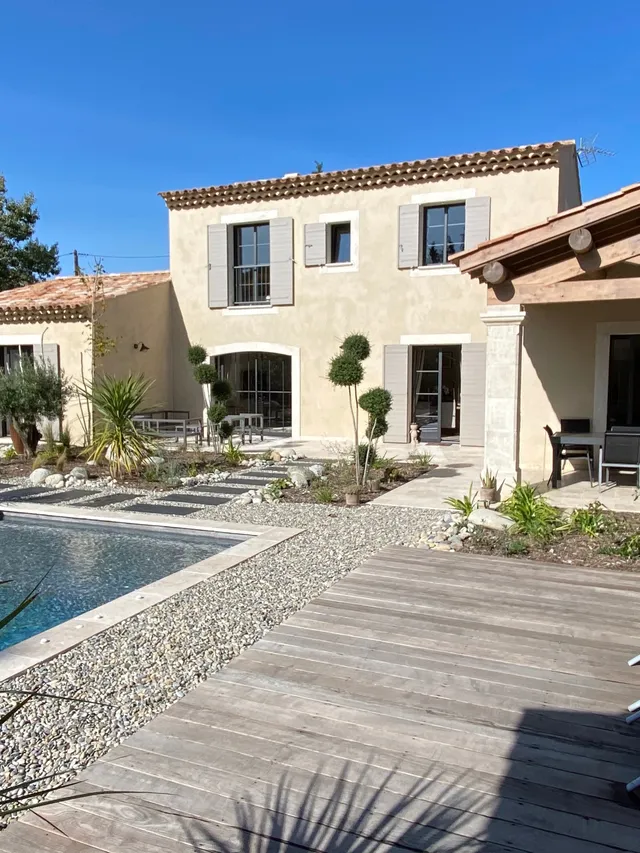
Saint-Rémy-de-Provence, Provence
Automated watering: a precious ally, but no magic
Programmed irrigation is the absent owner’s best friend: it waters early in the morning, regularly, without depending on anyone’s availability. Drip lines in particular deliver water to the foot of the plants with restraint and discretion.
Its limits are just as clear. A controller does not know that it has rained, that a sprinkler is blocked or that a joint has come apart underground. It keeps watering to its settings, blind and faithful. Add the real-world constraints: local water cuts, communal restrictions in drought periods, a failing power supply, and you understand why automation never replaces a visit.
The sensible rule: automate, then have it checked. At every visit to the property, checking the controller, the visible sprinklers and the state of the soil catches most drift. A regular reading of the water meter, recorded each time, completes the setup: consumption that climbs without reason almost always announces a leak.
Who does what when you live abroad?
The division of labour is simple once set out in advance. You decide the standard of upkeep, the calendar and the budget. The gardener works to the written scope, photographs and reports. The Home Select concierge service coordinates the whole: making sure the schedule holds, chasing when the gardener slackens, adjusting the frequency to the season’s weather and reporting back at every step. If the garden also holds a swimming pool, the dossier on pool maintenance from a distance deserves the same organisation.
A property held from abroad is prepared from the purchase. During the viewings, your Home Select property finder spots what will need upkeep; before the signing, they introduce the concierge service that will watch over the house in your absence.
After the keys, the Home Select concierge service organises the visits, the call-outs and the photographed reports. Tradespeople, the insurer and the managing agent act under their own responsibility; you decide on documents, wherever you are.
Frequently asked questions
Does a garden need a gardener all year if the property is only used in summer?
Yes, because plants do not follow your travel calendar: spring growth and the summer drought are precisely the critical periods. A lighter rhythm mid-season and a firmer one from spring to late summer is usually enough.
Does automated watering remove the need for visits?
No. A controller waters to fixed settings and detects neither breakage, nor a blocked sprinkler, nor a buried leak. Regular visits with photos remain essential to check the equipment and the real state of the garden.
How can I check a gardener’s work from abroad?
Through time-stamped photos at every visit, always taken from the same angles, and a written scope describing each expected task. Comparing month-on-month photos quickly shows whether the contract is being honoured.
What does a garden become in one season with nobody there?
The neglected-garden storyline nearly always unfolds the same way. In spring, the lawn takes a week’s head start and soon passes ankle height: at that stage, mowing becomes a job that strains both machine and turf. Boundary shrubs grow towards the facade, rub the walls with every wind, hold moisture against the render and eventually block the windows. The previous autumn’s leaves rot in the gutters, and the first rain overflows down the walls.
Who does what when you live abroad?
The division of labour is simple once set out in advance. You decide the standard of upkeep, the calendar and the budget. The gardener works to the written scope, photographs and reports. The Home Select concierge service coordinates the whole: making sure the schedule holds, chasing when the gardener slackens, adjusting the frequency to the season’s weather and reporting back at every step. If the garden also holds a swimming pool, the dossier on pool maintenance from a distance deserves the same organisation.
Which garden tasks, season by season, when the house is empty?
In spring, mowing resumes and the shrubs get a first shaping cut; in summer, regular mowing, watering and watching over young plantings; in autumn, leaf collection, hedge trimming and path cleaning; in winter, pruning of large trees and fruit trees and draining the irrigation, outside frost periods. A check of the garden and the watering equipment goes with every visit to the property.
What should a gardener’s contract cover when you live abroad?
A written scope: mowing and cutting height, trimming hedges and shrubs with removal of green waste, weeding of paths, and what stays out of scope, high pruning, felling, treatments. Then a frequency adjusted to the season, before and after photos from the same angles at every visit, a simple channel to report the unexpected, and a continuity plan if the gardener stops working.
Preparing a purchase in France from abroad, or already an owner there? Describe your situation: a Home Select property finder answers within one working day, and the file starts with the right partners, in the right order.
Your request is already sent, simply pick what suits you.
A property finder calls you back within one working day.
🇫🇷+33
An error occurred. Please try again.
Then answer 3 quick questions to be matched with the right hunter.
Home Select processes your data (name, email, phone, project) to handle your request and contact you. It is recorded in our follow-up tool and read by the hunter in charge of your project. Our technical providers access it for hosting, email and checking that your email and number are real, some of them from the United States under the safeguards set by the GDPR. We keep it for three years after our last exchange, or five years after the end of our assignment if you entrust it to us, as French anti-money-laundering law requires. To access, correct or erase it, or to object to its use: contact@home-select.fr. Details in our privacy policy.
Your hunter calls you back within one working day.
Resume your request?
You started a request recently. Pick up where you left off, or start over.
Your answers are kept for 24 hours.
What is your project?
Takes 1 minute, no commitment.
Where are you looking?
Select one or more cities or areas
Your budget?
€
You pay only when Home Select finds it.
Anything to add?
Optional. Add any useful details: specifics about your search, constraints or your availability.
This helps your hunter prepare for your call.
An expert will contact you shortly
Your brief
Confidential search: your file goes to a senior hunter.
60 rue François 1er, 75008 Paris · FCI member
FeesOne month’s rent excluding charges, plus VAT, with a minimum of €2,000 including VAT. Payable only when the lease is signed. No application fee.
Step 1 of 2 · Your search
What are you looking for?
Furnished, unfurnished or both?
In which city?
One or more cities or areas.
€ / month
Charges included, as in the listings.
You would like to move in
Two minutes, no documents needed at this stage.
FeesOne month’s rent excluding charges, plus VAT, with a minimum of €2,000 including VAT. Payable only when the lease is signed. No application fee.
Step 2 of 2 · Your situation
Your situation
These answers let Home Select tell you quickly, and frankly, whether your search can succeed on the market in your city.
You are applying
€ / month
Before tax, regular bonuses included, for everyone applying.
Main applicant’s employment
Your company is based in France
Number of annual accounts filed
To strengthen your file
Optional for your profile. A guarantee reassures landlords.
Guarantor’s situation
€ / month
Who it is for, why you are moving, what matters to you. Do not include sensitive information (health, origin, religion, family situation).
Your contact details
🇫🇷+33
Reply within 24 business hours.
Home Select processes your data (name, email, phone, project, employment, income, guarantee) to review your rental request and contact you. Your answers are compared with the criteria landlords apply, then read by Home Select’s rental hunter. A request that cannot succeed receives a written reply within 24 business hours, and you can ask for it to be reviewed again at contact@home-select.fr. Our technical providers access it for hosting, email and checking that your email and number are real, some of them from the United States under the safeguards set by the GDPR. A request that does not lead to an assignment is erased after three months; otherwise, we keep your data for three years after our last exchange, or five years after the end of our assignment if you entrust it to us, as French anti-money-laundering law requires. To access, correct or erase it, or to object to its use: contact@home-select.fr. Details in our privacy policy.
FeesOne month’s rent excluding charges, plus VAT, with a minimum of €2,000 including VAT. Payable only when the lease is signed. No application fee.
Your file
Your file matches what landlords expect
Book your meeting with Stéphane Martins, rental hunter. He confirms it after reading your file, within 24 business hours.
Choose your time slot
Times shown in Paris time.
Confirmation arrives by email and text message.
FeesOne month’s rent excluding charges, plus VAT, with a minimum of €2,000 including VAT. Payable only when the lease is signed. No application fee.
Your request
Your request is in good hands
Stéphane Martins, rental hunter, is reviewing your file and will reply within 24 business hours.
You will receive a confirmation email.
You arrived through one of Home Select’s ads or campaigns.Ad measurement.Do you agree to Home Select measuring how well it works? Home Select will know which campaign brought you here and, if you get in touch, the ad platform will only learn that its ad worked, without receiving your contact details.Do you agree to Home Select measuring how well its ads work? If you arrive through one of them, Home Select will know which one and, if you get in touch, the ad platform will only learn that its ad worked, without receiving your contact details.Learn moreYour current choice: .