Managing works in France from abroad: brief, quotes, project manager, remote follow-up and handover
Renovating a property in France while living abroad is feasible, and even common: what makes a remote project succeed is not presence, it is the framework. A written brief, comparable quotes, one person leading on site, progress reports at a set time and a formal handover. This dossier describes that framework, the absent owner’s pitfalls, and what Home Select organises after the signing.
By Jean Mascla, founder of Home SelectUpdated · 10 min read
Why does a works project drift so quickly without a method?
A tradesperson is waiting for your answer on where a radiator should go. A plasterer finds a damp partition behind some tiling. The building manager insists on a specific slot for bringing materials upstairs. Each of these events is routine on a building site. From a distance, each one becomes a waiting game: the question goes out in your evening, the answer comes back the next day in theirs, and in the meantime nobody works. Repeated over weeks, this friction pushes back the schedule, stretches the budget and wears everyone down.
The drift also has silent causes. A scope described "roughly" becomes a different project in every head. A quote accepted without a schedule says nothing about the order of interventions. A payment made in advance removes your main lever. And older properties keep surprises in their walls as well as their floors: an owner on site adjusts on the spot, an absent owner often finds out far too late.
The answer is neither to run everything yourself from abroad nor to delegate everything in one blind block. It is a method in five stages, each with a written deliverable:
Stage
Purpose
Expected deliverable
1. Frame
Fix the use, the scope and the constraints
Written brief and initial photo file
2. Cost
Obtain genuinely comparable quotes
Detailed quotes and budget with contingency
3. Run
Appoint a single point of contact on site
Written management brief with a clear scope
4. Track
Validate stage by stage, with evidence
Progress file, milestone by milestone, with dated photos
5. Sign off
Close cleanly and clear the snags
Handover report and cleared snags
Stage one: how do you frame the project and the intended use of the property?
Before discussing money, answer one simple question in writing: what will this property be for, for whom, and in what condition? The level of finish for a rental flat is neither that of a family second home nor that of a home prepared for a permanent return to France. This intended use drives the scope of works, the choice of materials and the calendar: expensive finishes are wasted on a let, hasty finishes cost you dearly on a home you will occupy yourself.
Then put together a brief, even a simple one: one to two pages describing, room by room, what is to be done, what is to be kept and what stays out of scope. Specify the items you are not opening up, ducts, structure, joinery, so that no quote sweeps them in "to be safe". Attach a dated photographic record of the initial condition, taken during a stay or by someone mandated for that purpose: without a visual starting point, you can neither track progress nor document a possible dispute.
For an older property, add the useful surveys: condition of the electrical installation, lead or asbestos survey, signs of damp. These documents steer quotes far better than a phone description, and they prevent the price caveats that let the tradesperson off the hook. Finally check the constraints outside the property itself: co-ownership authorisations for works, local planning rules for any change to the facade or any new opening. A well-framed project is a project you can hand over.
Expected deliverable: a written brief, an initial photo file, a list of known constraints.
Stage two: how do you cost the works through comparable quotes?
Costing starts with an identical enquiry pack given to every tradesperson: the same photos, the same plans, the same description of the work, the same access constraints. Without this common base, quotes reflect different projects and cannot be compared. Ask for a line-by-line document with quantities and unit prices rather than an overall range: it is the only way to spot items present in one quote and absent from another, such as rubble removal, floor protection or making good in the common areas.
Then compare excluding and including tax, line by line, and be wary of quotes that merge everything into a single total. The full approach is detailed in two articles of this category: requesting and comparing tradespeople’s quotes from abroad to build the enquiry, and what to check before signing a building quote remotely to read the binding details.
To build your panel of tradespeople, two routes: your local contacts, where they exist and are current, or a search for trusted service providers carried out for you among vetted professionals. For an older property, finally include a contingency in your budget: discoveries are the norm there, not the exception, and this margin saves you from recasting the whole project when the first partition comes off.
Expected deliverable: quotes that can be compared with one another, and a consolidated budget including contingency.
Stage three: who should run the works?
This is the decision that shapes all the others. Depending on the scale of the project, three figures can run the works. The architect, mandatory above a surface threshold set by law for works subject to planning permission, designs the project, handles the administrative file and directs execution. The project manager designs and directs more modest projects: drawings, tendering, site supervision. Works coordination, last, organises the daily routine for an absent owner: access to the property, appointments, reminders, reports, without replacing building professionals.
The principle to remember fits in one sentence: a single point of entry. Tradespeople need quick answers and physical access to the property; you need filtered, reliable, written information arriving at an hour compatible with your time zone. A works and renovation coordination service holds precisely that role: the coordinator knows the project, acts as the link on site, documents each stage and reports back to you. You keep the decisions; someone else chases keys and time slots.
Expected deliverable: a written management brief specifying the scope, the communication channel and the reporting rhythm.
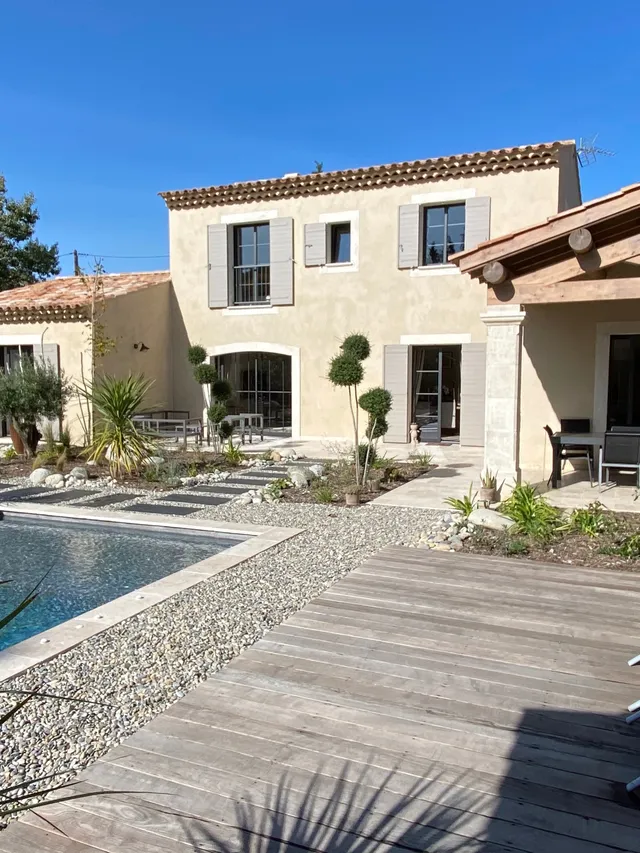
Aix-en-Provence, Provence
Stage four: how do you track progress through milestones and photographic evidence?
A building site is tracked through milestones, not impressions. Break the project into readable stages: preparation and strip-out, structural works, electrical and plumbing networks, second fix, finishing. For each completed milestone, require the same evidence: photos taken from the same angles, dated, compared with those of the previous milestone. This visual memory, built up across the whole project, is worth more than any verbal report and serves as a reference in case of disagreement.
Hold a regular call with whoever runs the works, by video conference, at a rhythm fixed from the start rather than whenever worries build up. Keep a shared site diary: decisions taken, open questions, upcoming visits, snags raised. Align payments with validated milestones: French rules do in fact schedule instalments for certain works. The rule is simple: you pay for a stage that has been verified, never for a hoped-for calendar.
The small everyday hiccups, a seal to redo, a handle to replace, a faulty switch, belong with handyman jobs and minor repairs rather than a fresh tender. Grouping them as the project unfolds avoids mobilising a tradesperson for three visits and keeps the main site focused on the essentials.
Expected deliverable: a complete progress file, milestone by milestone, with photos.
Stage five: how do you sign off the works and clear the snags?
Handover is when everything is decided. In practice: a room-by-room visit, with the tradespeople concerned present, a written list of snags, meaning anything badly done, unfinished or non-compliant, and a handover report recording those snags. Never sign a report "on trust" without this list: it underpins your guarantees.
French law indeed organises protections after handover. Defects reported during the year that follows fall under the perfect completion guarantee, at the expense of the company that caused them. Some fittings benefit from a proper-functioning guarantee. The most serious damage falls under the ten-year insurance the law requires from your builders. So always report defects in writing, however minor, as soon as they appear.
From abroad, a physical handover is not always possible. Two options: travel for this milestone, often the most useful trip of the whole project, or mandate a trusted person with a precise room-by-room checklist and instructions to record everything in writing and in photos. In both cases, do not pay the final balance until the snags are cleared and documented: the balance is your last lever.
Expected deliverable: a signed handover report, a list of snags, then documented proof they have been cleared.
What are the classic mistakes of the absent owner?
The same setbacks repeat from one project to the next. Here they are, with the remedy:
Mistake of the absent owner
What it leads to
The remedy
Describing the project over the phone
Every party understands a different version
A written brief, given to everyone
Paying regardless of progress
No lever left to have work redone
Payments tied to validated milestones
Multiplying contacts
Nobody feels responsible for the whole
One lead: architect, project manager or coordination
Overlooking access to the property
Tradespeople stuck at a locked door
Key logistics planned from the framing stage
Confusing quote and schedule
A site without a calendar drifts silently
A written schedule before signing
Never visiting
Silent defects turn into damage
At the very least, an organised presence at handover
The mother of all these mistakes remains the absence of method: believing a video call will replace a written framework. The five stages above are self-sufficient on a simple project; on a full renovation, they are best carried by someone whose trade it is.
What Home Select organises for your works
Works are costed before the purchase offer, not after: your Home Select property finder brings a contractor or a project manager to the second viewing, so that the price offered accounts for what remains to be done. That is also when it is decided who will lead, and how often you will be informed.
After the signing, we introduce you to the project manager or architect who runs the site in your place, and the concierge service that opens the door, receives deliveries and photographs progress. Running the works, the quotes and the handover are theirs, under their responsibility: our role is that there is a single point of entry, and that you decide on documents.
Frequently asked questions
Can I really carry out works in France without being there?
Yes, provided the project is framed in writing, someone local runs the day-to-day and progress is tracked through documented milestones. The owner’s physical presence still matters at key moments, notably at handover. In between, reliable coordination and photographic evidence are enough for most decisions.
Who can let tradespeople into my home in my absence?
Any trusted person mandated for that purpose: a relative, a neighbour acting as a relay or a dedicated local contact. What matters is organising key handovers, time slots and written reports. Without organised access, even the best quote in the world never gets started.
How should I pay for works while living abroad?
Through instalments tied to validated milestones, never in a single payment at the start. French rules schedule and cap payments for certain works. Each payment should match a stage that has been verified, ideally with dated photographs.
Why does a works project drift so quickly without a method?
A tradesperson is waiting for your answer on where a radiator should go. A plasterer finds a damp partition behind some tiling. The building manager insists on a specific slot for bringing materials upstairs. Each of these events is routine on a building site. From a distance, each one becomes a waiting game: the question goes out in your evening, the answer comes back the next day in theirs, and in the meantime nobody works. Repeated over weeks, this friction pushes back the schedule, stretches the budget and wears everyone down.
Stage one: how do you frame the project and the intended use of the property?
Before discussing money, answer one simple question in writing: what will this property be for, for whom, and in what condition? The level of finish for a rental flat is neither that of a family second home nor that of a home prepared for a permanent return to France. This intended use drives the scope of works, the choice of materials and the calendar: expensive finishes are wasted on a let, hasty finishes cost you dearly on a home you will occupy yourself.
Stage two: how do you cost the works through comparable quotes?
Costing starts with an identical enquiry pack given to every tradesperson: the same photos, the same plans, the same description of the work, the same access constraints. Without this common base, quotes reflect different projects and cannot be compared. Ask for a line-by-line document with quantities and unit prices rather than an overall range: it is the only way to spot items present in one quote and absent from another, such as rubble removal, floor protection or making good in the common areas.
Preparing a purchase in France from abroad, or already an owner there? Describe your situation: a Home Select property finder answers within one working day, and the file starts with the right partners, in the right order.
Your request is already sent, simply pick what suits you.
A property finder calls you back within one working day.
🇫🇷+33
An error occurred. Please try again.
Then answer 3 quick questions to be matched with the right hunter.
Home Select processes your data (name, email, phone, project) to handle your request and contact you. It is recorded in our follow-up tool and read by the hunter in charge of your project. Our technical providers access it for hosting, email and checking that your email and number are real, some of them from the United States under the safeguards set by the GDPR. We keep it for three years after our last exchange, or five years after the end of our assignment if you entrust it to us, as French anti-money-laundering law requires. To access, correct or erase it, or to object to its use: contact@home-select.fr. Details in our privacy policy.
Your hunter calls you back within one working day.
Resume your request?
You started a request recently. Pick up where you left off, or start over.
Your answers are kept for 24 hours.
What is your project?
Takes 1 minute, no commitment.
Where are you looking?
Select one or more cities or areas
Your budget?
€
You pay only when Home Select finds it.
Anything to add?
Optional. Add any useful details: specifics about your search, constraints or your availability.
This helps your hunter prepare for your call.
An expert will contact you shortly
Your brief
Confidential search: your file goes to a senior hunter.
60 rue François 1er, 75008 Paris · FCI member
FeesOne month’s rent excluding charges, plus VAT, with a minimum of €2,000 including VAT. Payable only when the lease is signed. No application fee.
Step 1 of 2 · Your search
What are you looking for?
Furnished, unfurnished or both?
In which city?
One or more cities or areas.
€ / month
Charges included, as in the listings.
You would like to move in
Two minutes, no documents needed at this stage.
FeesOne month’s rent excluding charges, plus VAT, with a minimum of €2,000 including VAT. Payable only when the lease is signed. No application fee.
Step 2 of 2 · Your situation
Your situation
These answers let Home Select tell you quickly, and frankly, whether your search can succeed on the market in your city.
You are applying
€ / month
Before tax, regular bonuses included, for everyone applying.
Main applicant’s employment
Your company is based in France
Number of annual accounts filed
To strengthen your file
Optional for your profile. A guarantee reassures landlords.
Guarantor’s situation
€ / month
Who it is for, why you are moving, what matters to you. Do not include sensitive information (health, origin, religion, family situation).
Your contact details
🇫🇷+33
Reply within 24 business hours.
Home Select processes your data (name, email, phone, project, employment, income, guarantee) to review your rental request and contact you. Your answers are compared with the criteria landlords apply, then read by Home Select’s rental hunter. A request that cannot succeed receives a written reply within 24 business hours, and you can ask for it to be reviewed again at contact@home-select.fr. Our technical providers access it for hosting, email and checking that your email and number are real, some of them from the United States under the safeguards set by the GDPR. A request that does not lead to an assignment is erased after three months; otherwise, we keep your data for three years after our last exchange, or five years after the end of our assignment if you entrust it to us, as French anti-money-laundering law requires. To access, correct or erase it, or to object to its use: contact@home-select.fr. Details in our privacy policy.
FeesOne month’s rent excluding charges, plus VAT, with a minimum of €2,000 including VAT. Payable only when the lease is signed. No application fee.
Your file
Your file matches what landlords expect
Book your meeting with Stéphane Martins, rental hunter. He confirms it after reading your file, within 24 business hours.
Choose your time slot
Times shown in Paris time.
Confirmation arrives by email and text message.
FeesOne month’s rent excluding charges, plus VAT, with a minimum of €2,000 including VAT. Payable only when the lease is signed. No application fee.
Your request
Your request is in good hands
Stéphane Martins, rental hunter, is reviewing your file and will reply within 24 business hours.
You will receive a confirmation email.
You arrived through one of Home Select’s ads or campaigns.Ad measurement.Do you agree to Home Select measuring how well it works? Home Select will know which campaign brought you here and, if you get in touch, the ad platform will only learn that its ad worked, without receiving your contact details.Do you agree to Home Select measuring how well its ads work? If you arrive through one of them, Home Select will know which one and, if you get in touch, the ad platform will only learn that its ad worked, without receiving your contact details.Learn moreYour current choice: .