Looking after an empty house while you live abroad: the tasks at every visit, every season, every year
An empty house is kept up through regular gestures, not major works: at every visit, every season, once a year. That rhythm always costs less than repairs after a claim, and it is easy to delegate when you live abroad. This dossier lists the tasks, how often to do them and why each one matters.
By Jean Mascla, founder of Home SelectUpdated · 7 min read
Why does regular upkeep always cost less than repair?
In an empty house, time works against you. Water damage discovered months after it began has had all that time to spread: floorboards, skirting, partition, insulation. A gutter overflowing at every rain soaks the wall, and the wall eventually says so, in its own way, through a stain first, then crumbling render. A house does not wait: every small fault left alone becomes a major fault.
Regular upkeep brings a second, less visible benefit: it trains the eye. Whoever visits every month spots immediately what has changed, where an occasional caller no longer sees anything.
Insurance does not change this mechanism, it complicates it: a loss on a clearly unkept property may be compensated at a discount, if at all. Conversely, documented upkeep, with dates and photos, credits your file and eases the exchanges with the insurer on the day you have to claim.
Hence the principle: maintain a little, often, rather than a lot, too late. And keep to a rhythm, because an empty house does not forgive improvisation.
What are the systematic gestures at every visit?
Whatever the reason for the visit, a short sequence covers the essentials:
Open the windows and air every room for a few minutes, enough to renew the air and spot abnormal smells.
Look for signs of damp: stains on the ceiling, blistering paint, a musty smell that lingers after airing.
Work the shutters and window handles: a seized mechanism can be released as long as it has not broken.
Run a little water at every tap and flush the toilet: stagnant water leaves deposits, and dried-out traps let smells rise.
Collect the mail, check that shutters and gates are properly closed, note any sign of an attempted break-in.
Shut off the water when leaving, after the visit, and drain what can be drained before a long absence.
These visits are precisely the purpose of an inspection visit with a photo report: a trained visitor applies the sequence at every call and leaves you a dated record, valuable for the insurer too.
Which points of vigilance for every season?
Autumn: gutters, downpipes and drainage grilles cleared of leaves; visual check of the roof after the summer storms; trees close to the roof pruned if needed.
Winter: general water shut-off and draining of the network during a prolonged absence; bleeding of the circuits; check that the precautions required by the insurance policy are in place.
Spring: shower and sanitary seals redone when the silicone cracks; moss treated on terraces and paths; exterior joinery and shutters inspected after the frost.
Summer: storm drainage and gullies tested before the heavy storms; ventilation grilles dusted; plant room aired and checked before the hot season.
Once a year: the full annual round
The water heater: check the safety group and the valve, and the anode for cylinders fitted with one.
Taps and flexible hoses: replace what is perishing, tighten what drips, look behind the machines.
The roof: check from the ground, displaced tiles, flashings, ridges, or by a roofer if the house lends itself to it.
The chimney: sweeping when local rules or the insurer require it, with the certificate carefully kept.
The locks: oil the cylinders and the hinges, check how doors sit, look at the latches.
The contracts: energy, water, insurance: reread the guarantees, update the payment details from abroad, cancel what has become useless.
The stays: preparing your arrival and closing up on departure, which is exactly the purpose of an inspection visit with a written report, so you find a house ready to live in and leave it closed properly.
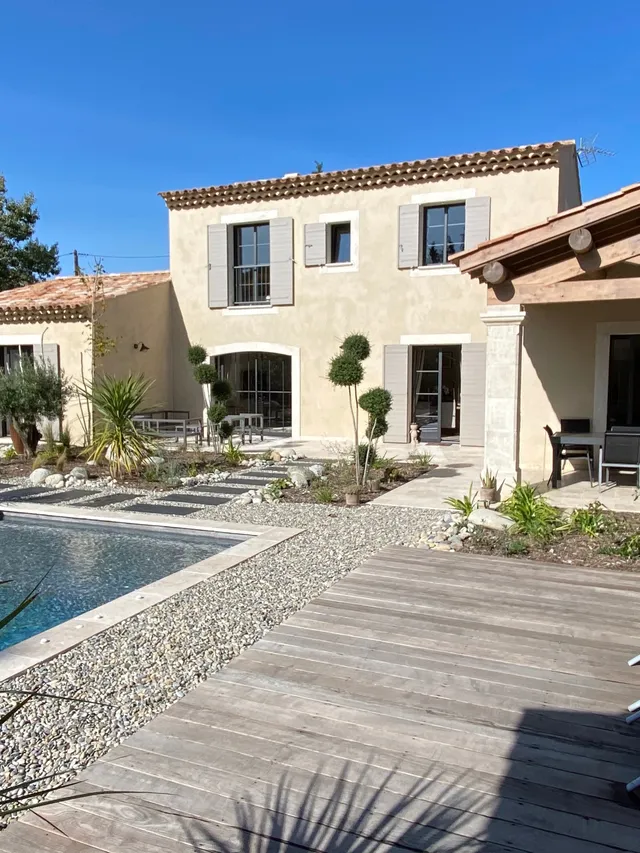
Eygalières, Provence
The summary table: frequency, gesture, why
Frequency
Gesture
Why
At every visit
Air every room
Renew the air and spot the smells that betray damp or a leak
At every visit
Look for damp marks and stains
Damage detected early stays small
At every visit
Run every tap
Avoid deposits and keep the seals supple
At every visit
Shut off the water when leaving
Limit the consequences of a leak during the vacancy
At every visit
Work the shutters and windows
Loosen the mechanisms before they break, and suggest a presence
Every autumn
Clean the gutters and downpipes
A full gutter overflows onto the facade and soaks the walls
Every winter
Drain the network during a long absence
Frost bursts pipes, and the guarantee applies only if the precautions are taken
Every spring
Redo the seals and treat the moss
Water seeps through the faults left open
Every spring
Inspect the shutters and joinery
Frost opens the timber, rain then gets in
Once a year
Check the water heater and its safety group
A scaled cylinder or a stuck valve gives way at the worst moment
Once a year
Check the roof and sweep the chimney if needed
One displaced tile is enough to start a lasting leak
Once a year
Reread the contracts and payment details
The contracts of an empty property renew themselves unnoticed
At every stay
Prepare the arrival, close up the departure
The house stays liveable and is closed according to the rules of the art
Who does what when you live abroad?
The frequent visits are delegated: you cover them during your stays, a relative can take a few, and a professional inspection visit guarantees the rest, with a report each time. The technical gestures, sweeping, roofing, plumbing, belong to tradespeople who are chosen and monitored: the Home Select concierge service identifies trusted providers, coordinates the interventions and reports back to you. The annual calendar is set once, then repeated: that is what turns the list into a reflex. Every ticked gesture leaves a trace, and every trace prepares the next.
An empty house does not need more upkeep than any other: it needs more method, because nobody is there to watch the faults appear.
What Home Select organises for your house’s upkeep
A property held from abroad is prepared from the purchase. During the viewings, your Home Select property finder spots what will need upkeep; before the signing, they introduce the concierge service that will watch over the house in your absence.
After the keys, the Home Select concierge service organises the visits, the call-outs and the photographed reports. Tradespeople, the insurer and the managing agent act under their own responsibility; you decide on documents, wherever you are.
Frequently asked questions
How often should an empty house be visited?
A monthly rhythm is recommended for a fully empty house, with closer watch in winter, when frost and damp do the most damage. Also check your insurance policy: it may impose a minimum visit frequency to keep certain guarantees.
Should the water be shut off during a long absence?
Yes, it is the single most effective gesture to limit the consequences of a leak during the vacancy. In winter, shutting off goes together with draining the network: the frost guarantee of insurance policies is often conditional on these precautions, cutting the water and emptying the pipes.
Who can carry out this checklist on my behalf?
The regular visits can be entrusted to an inspection visit with a photo report; the technical gestures, chimney sweeping, roofing, plumbing, belong to chosen and monitored tradespeople. The Home Select concierge service coordinates the whole and reports back to you.
Why does regular upkeep always cost less than repair?
In an empty house, time works against you. Water damage discovered months after it began has had all that time to spread: floorboards, skirting, partition, insulation. A gutter overflowing at every rain soaks the wall, and the wall eventually says so, in its own way, through a stain first, then crumbling render. A house does not wait: every small fault left alone becomes a major fault.
Who does what when you live abroad?
The frequent visits are delegated: you cover them during your stays, a relative can take a few, and a professional inspection visit guarantees the rest, with a report each time. The technical gestures, sweeping, roofing, plumbing, belong to tradespeople who are chosen and monitored: the Home Select concierge service identifies trusted providers, coordinates the interventions and reports back to you. The annual calendar is set once, then repeated: that is what turns the list into a reflex. Every ticked gesture leaves a trace, and every trace prepares the next.
What should be checked once a year in an empty house?
The water heater and its safety valve, the taps and hoses, the roof and gutters, the chimney when sweeping is required, the locks, then the contracts: energy, water and insurance, reread and updated from abroad. This full round is best timed after winter, when the cold season’s damage shows.
Should you keep a record of an empty house’s upkeep?
Yes. Dated, photographed upkeep supports your file with the insurer on the day of a claim, when a visibly neglected property may be compensated at a discount. It also serves over the years: comparing the reports from one visit to the next reveals what is slowly deteriorating.
Preparing a purchase in France from abroad, or already an owner there? Describe your situation: a Home Select property finder answers within one working day, and the file starts with the right partners, in the right order.
Your request is already sent, simply pick what suits you.
A property finder calls you back within one working day.
🇫🇷+33
An error occurred. Please try again.
Then answer 3 quick questions to be matched with the right hunter.
Home Select processes your data (name, email, phone, project) to handle your request and contact you. It is recorded in our follow-up tool and read by the hunter in charge of your project. Our technical providers access it for hosting, email and checking that your email and number are real, some of them from the United States under the safeguards set by the GDPR. We keep it for three years after our last exchange, or five years after the end of our assignment if you entrust it to us, as French anti-money-laundering law requires. To access, correct or erase it, or to object to its use: contact@home-select.fr. Details in our privacy policy.
Your hunter calls you back within one working day.
Resume your request?
You started a request recently. Pick up where you left off, or start over.
Your answers are kept for 24 hours.
What is your project?
Takes 1 minute, no commitment.
Where are you looking?
Select one or more cities or areas
Your budget?
€
You pay only when Home Select finds it.
Anything to add?
Optional. Add any useful details: specifics about your search, constraints or your availability.
This helps your hunter prepare for your call.
An expert will contact you shortly
Your brief
Confidential search: your file goes to a senior hunter.
60 rue François 1er, 75008 Paris · FCI member
FeesOne month’s rent excluding charges, plus VAT, with a minimum of €2,000 including VAT. Payable only when the lease is signed. No application fee.
Step 1 of 2 · Your search
What are you looking for?
Furnished, unfurnished or both?
In which city?
One or more cities or areas.
€ / month
Charges included, as in the listings.
You would like to move in
Two minutes, no documents needed at this stage.
FeesOne month’s rent excluding charges, plus VAT, with a minimum of €2,000 including VAT. Payable only when the lease is signed. No application fee.
Step 2 of 2 · Your situation
Your situation
These answers let Home Select tell you quickly, and frankly, whether your search can succeed on the market in your city.
You are applying
€ / month
Before tax, regular bonuses included, for everyone applying.
Main applicant’s employment
Your company is based in France
Number of annual accounts filed
To strengthen your file
Optional for your profile. A guarantee reassures landlords.
Guarantor’s situation
€ / month
Who it is for, why you are moving, what matters to you. Do not include sensitive information (health, origin, religion, family situation).
Your contact details
🇫🇷+33
Reply within 24 business hours.
Home Select processes your data (name, email, phone, project, employment, income, guarantee) to review your rental request and contact you. Your answers are compared with the criteria landlords apply, then read by Home Select’s rental hunter. A request that cannot succeed receives a written reply within 24 business hours, and you can ask for it to be reviewed again at contact@home-select.fr. Our technical providers access it for hosting, email and checking that your email and number are real, some of them from the United States under the safeguards set by the GDPR. A request that does not lead to an assignment is erased after three months; otherwise, we keep your data for three years after our last exchange, or five years after the end of our assignment if you entrust it to us, as French anti-money-laundering law requires. To access, correct or erase it, or to object to its use: contact@home-select.fr. Details in our privacy policy.
FeesOne month’s rent excluding charges, plus VAT, with a minimum of €2,000 including VAT. Payable only when the lease is signed. No application fee.
Your file
Your file matches what landlords expect
Book your meeting with Stéphane Martins, rental hunter. He confirms it after reading your file, within 24 business hours.
Choose your time slot
Times shown in Paris time.
Confirmation arrives by email and text message.
FeesOne month’s rent excluding charges, plus VAT, with a minimum of €2,000 including VAT. Payable only when the lease is signed. No application fee.
Your request
Your request is in good hands
Stéphane Martins, rental hunter, is reviewing your file and will reply within 24 business hours.
You will receive a confirmation email.
You arrived through one of Home Select’s ads or campaigns.Ad measurement.Do you agree to Home Select measuring how well it works? Home Select will know which campaign brought you here and, if you get in touch, the ad platform will only learn that its ad worked, without receiving your contact details.Do you agree to Home Select measuring how well its ads work? If you arrive through one of them, Home Select will know which one and, if you get in touch, the ad platform will only learn that its ad worked, without receiving your contact details.Learn moreYour current choice: .