Signing at the notaire’s without coming to France: power of attorney, remote appearance and interpreter
No rule requires the buyer to be in the practice on the day of the deed. Since 2020 there are three routes: the notarised power of attorney, remote appearance by video conference and, for those who do not speak French, the interpreter. This dossier sets out what each requires, what it costs in lead time and what must be prepared from the preliminary contract.
By Jean Mascla, founder of Home SelectUpdated · 7 min read
The notarised power of attorney, the most common route
A property sale is recorded by a notarised deed received by a notary. A mandate given to sign such a deed must take the same form, under the rule of parallelism of forms: the power of attorney is therefore itself notarised, received by a notary. A power drawn up between private individuals, even signed before witnesses, even countersigned by a lawyer, will be set aside by the practice on the day of signing.
Drawn up in France, it is dealt with in a single appointment. Drawn up abroad, it goes through a local notary, then through an international circulation formality that depends on the country where you live. States party to the Hague Convention of 5 October 1961, which is most of Europe, the Americas and developed Asia, issue an apostille: a single stamp affixed by a designated authority, generally a ministry or a court. Countries outside the convention require legalisation through the diplomatic chain, which takes longer. A few bilateral conventions dispense with any formality.
Two logistical points matter. A power drawn up in a foreign language must come with a translation by a translator sworn before a French court of appeal. And the notarial function of French consulates, long used for these powers, has only been maintained at a small number of posts since 2019: better to ask the French practice which circuit it recommends in your country than to assume it.
Whom to appoint, and within what limits
Invariable practice is to give the power to a clerk of the practice receiving the deed. This is not a convenience: that clerk knows the file, has no personal interest in the transaction, and engages the practice’s professional liability. Giving the power to the seller or their agent creates an obvious conflict of interest. Giving it to a relative living in France exposes you to a misreading of a clause that person has no means of weighing.
The power given must be specific and precise. It names the property by address and land registry references, sets the maximum price, restates the essential conditions and the payment arrangements. A general power, of the "represent the principal in all their affairs" kind, is not enough and will be refused. That precision is your protection: the attorney can accept only what you wrote.
Allow two to four weeks between the request and receipt of the document by the French practice, depending on the country and the applicable formality. It is that delay, rather than the notary’s availability, that most often fixes the date of the deed.
Remote appearance, where the practice is equipped
The decree of 3 April 2020, made under the health emergency and then made permanent, opened up the remote electronic notarised deed. The notary receives the deed through a video system approved by the High Council of Notaries, verifies the parties’ identity, reads the deed to them, then collects a qualified electronic signature within the meaning of the European electronic identification regulation.
This route has two merits: it removes the transmission time for the power of attorney, and it puts you in the notary’s presence, where the deed is read to you and your questions answered, which a power of attorney does not allow. It has two limits: not every practice is equipped for it, and an appointment coordinated across two time zones is harder to fix than it looks when four people must be available at once.
Ask for it early, from the preliminary contract onwards, not three weeks before the deed. If the practice does not offer it, the deed may still be received by another practice acting jointly, but that is decided upstream.
If you do not speak French
The notary must be satisfied that each party understands the deed they are signing. Where one of them has no command of French, they call on an interpreter, who translates the reading and whose involvement is recorded in the deed. Some practices have bilingual notaries or staff, which simplifies matters without dispensing with the formality where the buyer’s language is not covered.
Do not treat this point as secondary. A deed received without the buyer having understood what they were signing is a fragile deed, and it is precisely in the clauses on easements, party walls and co-ownership charges that the surprises sit.
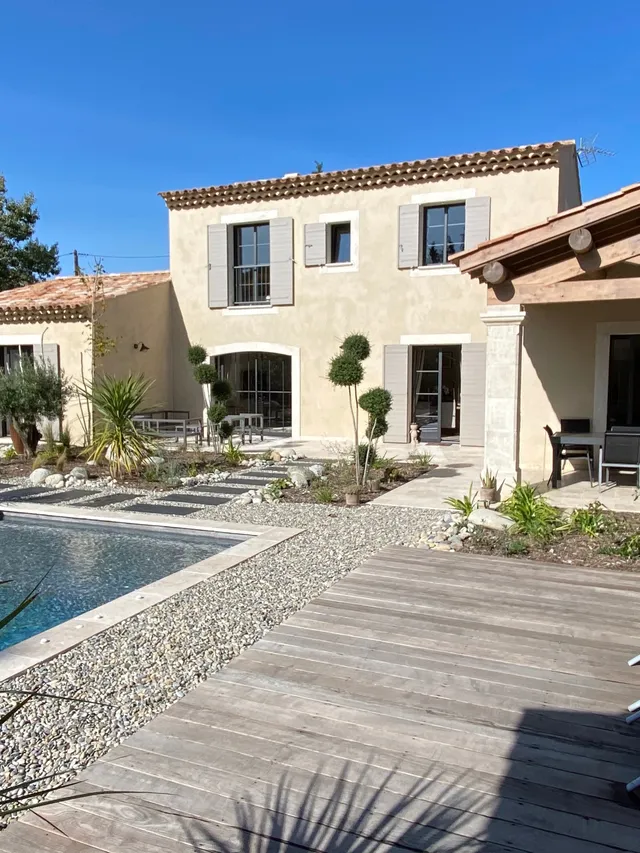
Uzès, Occitanie
What has to be prepared from the preliminary contract
Three things are started at the preliminary contract and not after. The power of attorney circuit, because it depends on foreign authorities whose timescales are not negotiable. The escrow transfer, which presupposes a euro account and an international banking delay, a subject covered in the timetable from offer to preliminary contract. And the question of an interpreter, where it arises.
Start from the deed date and work back. The power of attorney is launched four weeks earlier, apostille included. Remote appearance is set a week ahead. The documents the notary will ask for are gathered much earlier still, and the source of funds is the item that most often blocks a signature, on the day itself, for one missing piece.
A final point, which is anything but theoretical: funds must have arrived and been verified on the practice’s account at the time of signature, not be in transit. Three to five business days ahead is the practice, and a deed is not signed on a promise of payment.
Once the deed has been signed remotely, you will receive an attestation of ownership rather than the title itself: the certified copy only arrives months later, after registration, and that wait is entirely normal.
What Home Select organises for your remote signing
Home Select searches and negotiates for the buyer, and for the buyer alone. Your property finder checks the property, the building’s documents and the calendar before you commit, and flags what deserves a question to the notaire or a clause in the offer.
Around the purchase, we introduce the partners used to buyers who live abroad: bilingual notaire, mortgage broker, lawyer, sworn translator. Each acts under their own responsibility; we keep the calendar, from the offer to the handing over of the keys.
Frequently asked questions
Is a privately signed power of attorney enough to sign the deed?
No. A property sale is recorded by notarised deed, and a power of attorney given to sign a notarised deed must take the same form: that is the rule of parallelism of forms. The power is therefore received by a notary, French or foreign. A power drawn up between private individuals, even signed before witnesses, will be refused by the practice at signing.
Does a power of attorney drawn up abroad need an apostille?
It depends on the country. States party to the Hague Convention of 5 October 1961 issue an apostille, a single formality affixed by a designated local authority. Countries outside the convention require legalisation through the diplomatic chain, which takes longer. A few bilateral conventions dispense with any formality. In every case, a power in a foreign language comes with a translation by a sworn translator.
Whom should you appoint to sign in your place?
In practice, to a clerk of the notarial practice receiving the deed: they know the file, have no interest in the transaction and their professional liability is engaged. Never to the seller, their agent, or a relative who does not grasp the reach of the clauses. The power must be specific: it names the property, the maximum price and the conditions, and it does not allow anything other than what you decided to be accepted.
Can the deed be signed by video conference?
The decree of 3 April 2020, made under the health emergency and then made permanent, opened up the remote electronic notarised deed. The notary receives the deed through a video system approved by the High Council of Notaries, verifies the parties’ identity, reads the deed to them, then collects a qualified electronic signature within the meaning of the European electronic identification regulation.
What must be started as soon as the preliminary contract is signed?
Three things are started at the preliminary contract and not after. The power of attorney circuit, because it depends on foreign authorities whose timescales are not negotiable. The escrow transfer, which presupposes a euro account and an international banking delay, a subject covered in the timetable from offer to preliminary contract. And the question of an interpreter, where it arises.
Do you need an interpreter if you do not speak French?
Yes, and it is not a courtesy. The authentic deed is drawn up in French, and where a party does not understand that language, an interpreter must step in so that consent is informed. A practice working in your language removes that friction before it arises, and that is the first reason to choose it.
Preparing a purchase in France from abroad, or already an owner there? Describe your situation: a Home Select property finder answers within one working day, and the file starts with the right partners, in the right order.
Your request is already sent, simply pick what suits you.
A property finder calls you back within one working day.
🇫🇷+33
An error occurred. Please try again.
Then answer 3 quick questions to be matched with the right hunter.
Home Select processes your data (name, email, phone, project) to handle your request and contact you. It is recorded in our follow-up tool and read by the hunter in charge of your project. Our technical providers access it for hosting, email and checking that your email and number are real, some of them from the United States under the safeguards set by the GDPR. We keep it for three years after our last exchange, or five years after the end of our assignment if you entrust it to us, as French anti-money-laundering law requires. To access, correct or erase it, or to object to its use: contact@home-select.fr. Details in our privacy policy.
Your hunter calls you back within one working day.
Resume your request?
You started a request recently. Pick up where you left off, or start over.
Your answers are kept for 24 hours.
What is your project?
Takes 1 minute, no commitment.
Where are you looking?
Select one or more cities or areas
Your budget?
€
You pay only when Home Select finds it.
Anything to add?
Optional. Add any useful details: specifics about your search, constraints or your availability.
This helps your hunter prepare for your call.
An expert will contact you shortly
Your brief
Confidential search: your file goes to a senior hunter.
60 rue François 1er, 75008 Paris · FCI member
FeesOne month’s rent excluding charges, plus VAT, with a minimum of €2,000 including VAT. Payable only when the lease is signed. No application fee.
Step 1 of 2 · Your search
What are you looking for?
Furnished, unfurnished or both?
In which city?
One or more cities or areas.
€ / month
Charges included, as in the listings.
You would like to move in
Two minutes, no documents needed at this stage.
FeesOne month’s rent excluding charges, plus VAT, with a minimum of €2,000 including VAT. Payable only when the lease is signed. No application fee.
Step 2 of 2 · Your situation
Your situation
These answers let Home Select tell you quickly, and frankly, whether your search can succeed on the market in your city.
You are applying
€ / month
Before tax, regular bonuses included, for everyone applying.
Main applicant’s employment
Your company is based in France
Number of annual accounts filed
To strengthen your file
Optional for your profile. A guarantee reassures landlords.
Guarantor’s situation
€ / month
Who it is for, why you are moving, what matters to you. Do not include sensitive information (health, origin, religion, family situation).
Your contact details
🇫🇷+33
Reply within 24 business hours.
Home Select processes your data (name, email, phone, project, employment, income, guarantee) to review your rental request and contact you. Your answers are compared with the criteria landlords apply, then read by Home Select’s rental hunter. A request that cannot succeed receives a written reply within 24 business hours, and you can ask for it to be reviewed again at contact@home-select.fr. Our technical providers access it for hosting, email and checking that your email and number are real, some of them from the United States under the safeguards set by the GDPR. A request that does not lead to an assignment is erased after three months; otherwise, we keep your data for three years after our last exchange, or five years after the end of our assignment if you entrust it to us, as French anti-money-laundering law requires. To access, correct or erase it, or to object to its use: contact@home-select.fr. Details in our privacy policy.
FeesOne month’s rent excluding charges, plus VAT, with a minimum of €2,000 including VAT. Payable only when the lease is signed. No application fee.
Your file
Your file matches what landlords expect
Book your meeting with Stéphane Martins, rental hunter. He confirms it after reading your file, within 24 business hours.
Choose your time slot
Times shown in Paris time.
Confirmation arrives by email and text message.
FeesOne month’s rent excluding charges, plus VAT, with a minimum of €2,000 including VAT. Payable only when the lease is signed. No application fee.
Your request
Your request is in good hands
Stéphane Martins, rental hunter, is reviewing your file and will reply within 24 business hours.
You will receive a confirmation email.
You arrived through one of Home Select’s ads or campaigns.Ad measurement.Do you agree to Home Select measuring how well it works? Home Select will know which campaign brought you here and, if you get in touch, the ad platform will only learn that its ad worked, without receiving your contact details.Do you agree to Home Select measuring how well its ads work? If you arrive through one of them, Home Select will know which one and, if you get in touch, the ad platform will only learn that its ad worked, without receiving your contact details.Learn moreYour current choice: .